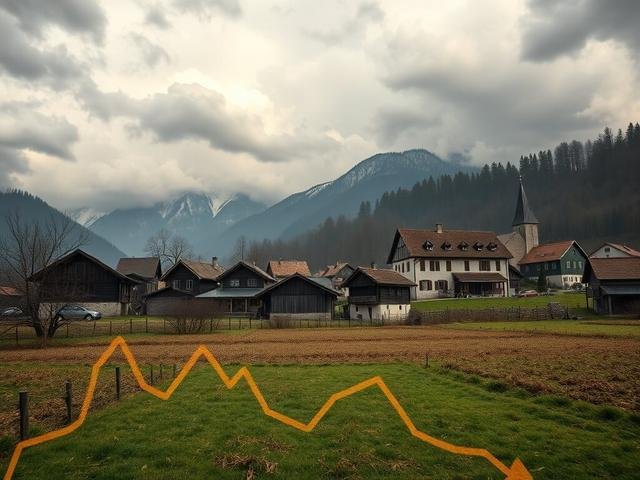
The Austrian economy is going through tough times. 😥 Recent forecasts from leading economic institutes such as WIFO and IHS indicate that the recession in the country may drag on. What does this mean for residents and businesses? Let's take a closer look.
The Austrian economy, like many others in Europe, faces serious challenges. Inflation, rising energy prices and geopolitical instability are putting significant pressure on economic growth. The forecasts of WIFO and IHS paint a picture of a slow and painful economic recovery. In this article, we take a closer look at what experts are saying, what factors are influencing the situation and what can be expected in the near future.
What do economic institutions say? 🗣️
The economic institutes WIFO (Austrian Institute for Economic Research) and IHS (Institute for Advanced Studies) regularly analyze the current economic situation and publish their forecasts. 📈 Recently, these forecasts have become increasingly cautious.
WIFO Forecasts: Moderate Optimism? 🤔
WIFO tends to be more moderate in its estimates. However, even its latest data points to a slowdown in economic growth.
IHS: A more pessimistic view 😟
IHS, on the other hand, often presents more pessimistic scenarios. Their analysts highlight the risks associated with high inflation and an unstable global economy. As the article on ORF website, economists expect the economic recovery to take longer than previously expected.
Factors Affecting Recession 🔍
Why did Austria end up in recession? There are several key factors that influence the economic situation in the country.
Inflation and energy prices ⛽
One of the main factors is high inflation, which significantly reduces the purchasing power of the population. The rise in energy prices caused by geopolitical events also puts pressure on businesses and households.
Geopolitical instability 🌍
Military conflicts and political tensions around the world create uncertainty and negatively affect investment and trade. As reported The Standard, geopolitical risks increase economic instability.
Impact on different sectors of the economy 🏢
The recession is affecting various sectors of the Austrian economy, but some are proving particularly vulnerable.
Tourism 🏞️
The tourism sector, which is important to the Austrian economy, is suffering due to a decline in tourist numbers and rising travel costs. Details can be found at news agency websites.
Industry 🏭
Industrial production faces supply chain challenges, rising raw material prices and declining export demand.
Construction 🏗️
The construction sector is also struggling due to high material prices and falling investment in new projects.
What can we expect in the future? 🔮
What are the prospects for the Austrian economy in the near future? The forecasts of WIFO and IHS give some insight into possible scenarios.
Slow recovery 🐌
Both institutions agree that the economic recovery will be slow and gradual. Inflation is expected to remain high for some time, which will hold back economic growth.
The need for structural reforms 🛠️
Structural reforms are needed to overcome the recession and ensure sustainable economic growth. This could include measures to improve competitiveness, reduce dependence on energy imports and support innovation.
Conclusion and findings
WIFO and IHS forecasts indicate that Austria will continue to experience economic difficulties in the near future. 📉 High inflation, geopolitical instability and problems in various sectors of the economy are putting pressure on economic growth. Structural reforms and adaptation to new economic realities are needed to overcome the recession.
If this article was helpful, please share it with your friends! 📢


