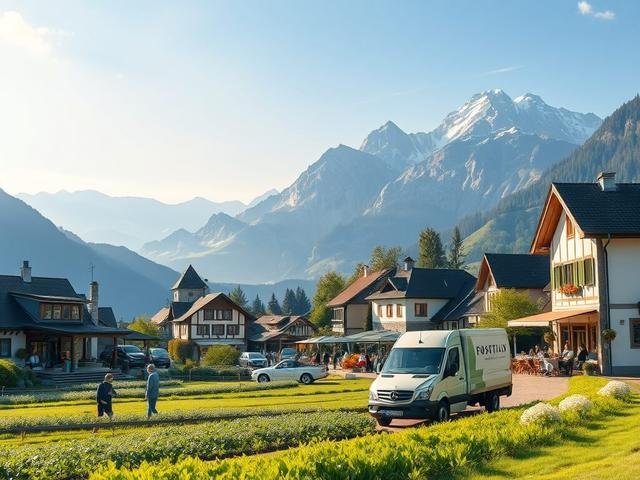
The Austrian economy is showing remarkable resilience in the face of global instability. 🌍 Despite the "Konjunkturflaute" (economic downturn), the country finds "Impulse für Wachstum" (growth impulses) and strengthens its "Wirtschaftsstandort" (economic standing). How does Austria manage to maintain positive trends when economic storms rage around it? Let's find out which factors play a key role in this process and what makes Austria attractive for business and investment. 🤔
Secrets of Austrian Economic Growth 🔑
Austria continues to show signs of growth despite global economic challenges. This is possible due to several key factors that allow the country to remain competitive and attractive to investors.
Strong small and medium businesses 🏢
Small and medium-sized enterprises (SMEs) are the backbone of the Austrian economy. They create the majority of jobs and make a significant contribution to the GDP.
- Flexibility and adaptability: SMEs are more adaptable to changing market conditions.
- Innovations: Many SMEs are actively implementing new technologies and developing innovative products.
- Regional development: SMEs play an important role in regional development, creating jobs and supporting local economies.
Focus on innovation and research 🔬
Austria invests heavily in research and development.
- Government support: The government provides grants and subsidies for innovative projects.
- Cooperation between business and science: Active interaction between universities and companies promotes the development of new technologies.
- Attracting Talent: Austria attracts highly qualified specialists from all over the world.
Strategic geographical location 🗺️
Austria is located in the center of Europe and has a developed transport infrastructure.
- Logistics hub: The country is an important logistics hub for trade between Eastern and Western Europe.
- Attractiveness for foreign investors: Many international companies choose Austria as a base for their activities in the region.
- Developed infrastructure: Modern roads, railways and airports provide efficient transportation of goods and people.
Competitiveness and sustainability 🏆
The Austrian economy has a high degree of resilience to external shocks. This is due to the diversified structure of the economy and sound economic policy.
Export support 📦
Austria is an export-oriented country. The government actively supports exporters by providing them with various tools and services.
- Export Credit Insurance: Helps companies minimize risks associated with exports.
- Trade missions: Organization of business trips for Austrian companies to other countries.
- Support for participation in international exhibitions: Assistance in promoting products on the global market.
Investment in education and qualifications 🎓
Austria places great emphasis on education and vocational training.
- Dual education system: A combination of theoretical training at school and practical work at the enterprise.
- Improving the qualifications of employees: Supporting companies that invest in training their employees.
- Attracting international students: Austrian universities offer a wide range of study programs for international students.
Environmental sustainability 🌱
Austria is actively developing a "green" economy and supports environmentally friendly technologies.
- Investments in renewable energy sources: Development of solar, wind and hydropower.
- Support for environmentally friendly technologies: Stimulating the development and implementation of new technologies that reduce the negative impact on the environment.
- Development of ecotourism: Attracting tourists interested in environmentally friendly holidays.
The Impact of "Konjunkturflaute" and Growth Prospects 📉📈
Despite the positive trends, the Austrian economy is also facing challenges related to the global economic downturn ("Konjunkturflaute").
- Decline in demand for exports: A decrease in export volumes due to a decrease in demand in other countries.
- Rising energy prices: Increased production and transportation costs.
- Inflation: An increase in the inflation rate, reducing the purchasing power of the population.
However, as the analysis shows Wirtschaftsstandort Österreich: Impulse für Wachstum trotz Konjunkturflaute, the Austrian economy has sufficient potential to overcome these difficulties.
Conclusion and findings
Austria continues to demonstrate resilience and growth despite global economic challenges. Strong small and medium-sized businesses, investment in innovation and research, a strategic geographical location, export support, investment in education and skills, and environmental sustainability are all factors that enable the country to remain competitive and attractive to investors. 💪
Despite the influence of the "Konjunkturflaute", the Austrian economy has good prospects for further growth. It is important to continue investing in innovation, supporting SMEs and developing a "green" economy. 🇦🇹
If you want to learn more about life and business in Austria, subscribe to our blog! 📝


