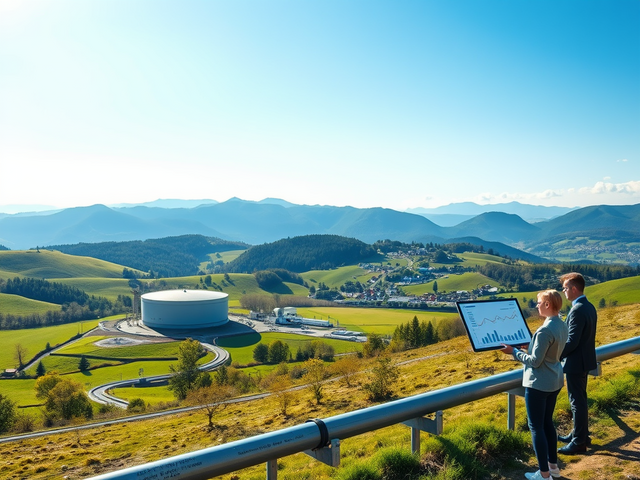
Gas reserves in Austria: what is the situation today?
Austria, like many other European countries, faces challenges in the field of energy security. In light of the recent events related to the cessation of gas supplies from Russia, many questions arise about the state of gas reserves in the country. 📉 According to the latest data, Austrian underground gas storage facilities (PHG) are filled to the level of 55%, which raises concerns among the population. However, experts are confident that gas reserves are sufficient to ensure a stable heat supply during the coming winter seasons. ❄️
In this article, we take a closer look at the current state of gas storage in Austria and analyze what this means for the country's future energy stability.
State of gas storage facilities in Austria 📊
Currently, gas storage facilities in Austria are at a capacity of 55%. This is, of course, below the required 60%, which is considered optimal for getting through the winter. According to experts, despite this, the energy supply remains stable, and the reserves will last for two cold winter seasons.
- In 2023, Austria covered 45% of its gas consumption from PHG.
- 24% was supplied with liquefied natural gas (LNG), and 16% came from Norway via Germany.
After the end of Russian gas transit through Ukraine in January, the level of reserves has fallen by more than 20%. However, experts from E-Control and the Austrian Energy Agency emphasize that there are enough resources for the coming winters. 🔍
Gas reserves: is there a risk of shortage? 🤔
Although the storage capacity level in Austria is currently 55%, it is important to note that the situation is better in other EU countries. For example, storage capacity in Germany is 91,79%, which creates some reserve capacity for mutual assistance in the event of a crisis. 💡
However, according to data E-Control, Austrian experts are confident that the current gas reserves are sufficient to get through the winter. The information that the storage facilities are filled to 90% confirms the reliability of the system. Moreover, only a small share of the total volume of gas stored in the country is intended for foreign consumers.
Gas sources: where does our gas come from? 🌍
According to the data, Austria has significantly reduced its dependence on Russian gas, reducing the percentage of imports from 79% to 21%. This was achieved by introducing new import flows, in particular via Ukraine and alternative routes. However, despite this, 57% of all imported gas still comes from Russia, highlighting the need to diversify sources. 📈
What are your plans for the future? 🗺️
The Austrian government is taking steps to improve the gas supply situation. In particular, efforts to attract liquefied natural gas and develop domestic resources have been stepped up. However, as experts note, these measures will not lead to immediate results, and the country still has to take significant steps towards energy independence.
Conclusion and findings 🔍
In conclusion, despite the current 55% fullness of gas storage facilities in Austria, experts assure that gas reserves are sufficient for the coming winters. However, the challenges associated with dependence on Russian supplies remain relevant. 🌨️
It is important that the Austrian government continues to work on diversifying sources and increasing energy security. Your point of view is important! Do you think Austria will be able to completely get rid of its dependence on Russian gas in the future? 🤔
If you found this article useful, please share it with your friends! 📢 Subscribe to our blog to stay up to date with new content about life in Austria! 📨
SEO Meta Description
Analysis of the current state of gas reserves in Austria: reserves at 55%, what does this mean for energy security?


