
Can Subsidiary Protection Holders Work in Austria? What Is Allowed
Can Subsidiary Protection Holders Work in Austria? What Is Allowed Can subsidiary protection holders work in Austria? Yes: free labour market access, documents, AMS registration, self-employment, family and status loss rules. Topics: Work, Labor Market, Politics.
Yes — subsidiary protection holders can work in Austria immediately and without any permit. People with subsidiary protection (subsidiär Schutzberechtigte) are treated exactly like recognised refugees: they are excluded from the Ausländerbeschäftigungsgesetz, the Austrian employment act for foreign nationals. No employer application to AMS (the Public Employment Service), no labour market test, no three-month waiting period. This guide explains how subsidiary protection differs from asylum, which documents to show an employer, how to register with AMS, what is allowed in self-employment, how family members join and work, and what happens to your job if the status is revoked. Every rule has been checked against official sources — oesterreich.gv.at, AMS and the Chamber of Labour — as of October 2026.
Short answer: yes, no permits and no labour market test
A person with subsidiary protection holds a form of international protection granted in Austria even when the refugee definition does not apply. For work purposes this changes everything: no Beschäftigungsbewilligung (employment permit) is needed. As AMS states, people recognised with international protection are exempt from the employment act for foreign nationals under § 1 Abs. 2 lit. a AuslBG. On request, the employment service issues a written confirmation of this exemption — useful to hand to employers.
A quick comparison removes the most common confusion — mixing up asylum seekers with people who already hold a status:
| Status | Labour market access | Permit needed |
|---|---|---|
| Asylum seeker | After 3 months from registration | Yes, from AMS |
| Recognised refugee | Full, immediate | No |
| Subsidiary protection | Full, immediate | No |
| Displaced persons from Ukraine | Free | No |
The contrast with asylum seekers is fundamental: they need an employer application, a labour market test and a specific job offer. If your own procedure is still running, start with our guide on work rules for asylum seekers — it also covers the 2026 GEAS reform.
How subsidiary protection differs from asylum
Both are forms of international protection, but the grounds differ. Refugee status requires personal persecution — because of race, religion, nationality, membership of a social group or political opinion. Subsidiary protection does not: a real risk of serious harm on return is enough — death penalty, torture or indiscriminate violence in an armed conflict. According to oesterreich.gv.at, the threat must come from a concrete “actor”, such as a state — natural disasters and pandemics do not qualify for the status.
For work, the practical difference is minimal: both statuses grant the same full labour market access. The differences appear elsewhere. A recognised refugee receives a Konventionsreisepass (refugee travel document), while a subsidiary protection holder can apply for a Fremdenpass (alien’s passport) if no national document can be obtained. Refugees may naturalise after 6 years of residence; subsidiary protection holders follow the general 10-year rule. And family reunification opens immediately for refugees with a three-month filing window, while subsidiary protection holders face a two-year waiting period — more on that below.
There is also a third group you should not confuse with either: displaced persons from Ukraine. They hold an Ausweis für Vertriebene (displaced person’s ID) and enjoy free labour market access without refugee status at all. Their right of residence, according to BMI, runs until 4 March 2028, and work access has been free since April 2023. If you arrived from Ukraine, you follow a separate roadmap with its own benefits — see our review of the new Familienbeihilfe rules.
Free labour market access: what it means in practice
Freier Arbeitsmarktzugang (free labour market access) means three things. First, you may sign an employment contract in any industry — hospitality, construction, IT, healthcare. Second, the employer has nothing to request: no permit, no check whether Austrian candidates exist. Third, there are no regional limits or hour caps; full-time and part-time positions are equally available.
Compare this with an asylum seeker, who can only take a job after the Arbeitsmarktprüfung — AMS checks whether registered unemployed Austrians could fill the vacancy. Subsidiary protection holders never face this test. According to BMI (the Interior Ministry), only 244 first-time asylum applications were lodged in July 2026 — roughly 65 percent fewer than a year earlier. The pool of people stuck in procedure is shrinking, while the labour market accepts status holders without any barriers.
One fast entry route deserves a mention: Leiharbeit (temporary staffing agencies). The agency employs you and assigns you to companies — warehouses, production lines, logistics. For newcomers it means starting within a week and sampling several industries, with pay protected by the same collective agreement. Demand is consistently high, which makes staffing a realistic first contract for anyone without Austrian experience.
The only real hurdle is language and qualifications. The law restricts nothing, but pay follows the Kollektivvertrag (collective agreement) of your industry. Base rates across common sectors are covered in our guide to working in Austria.
Which documents you need for employment
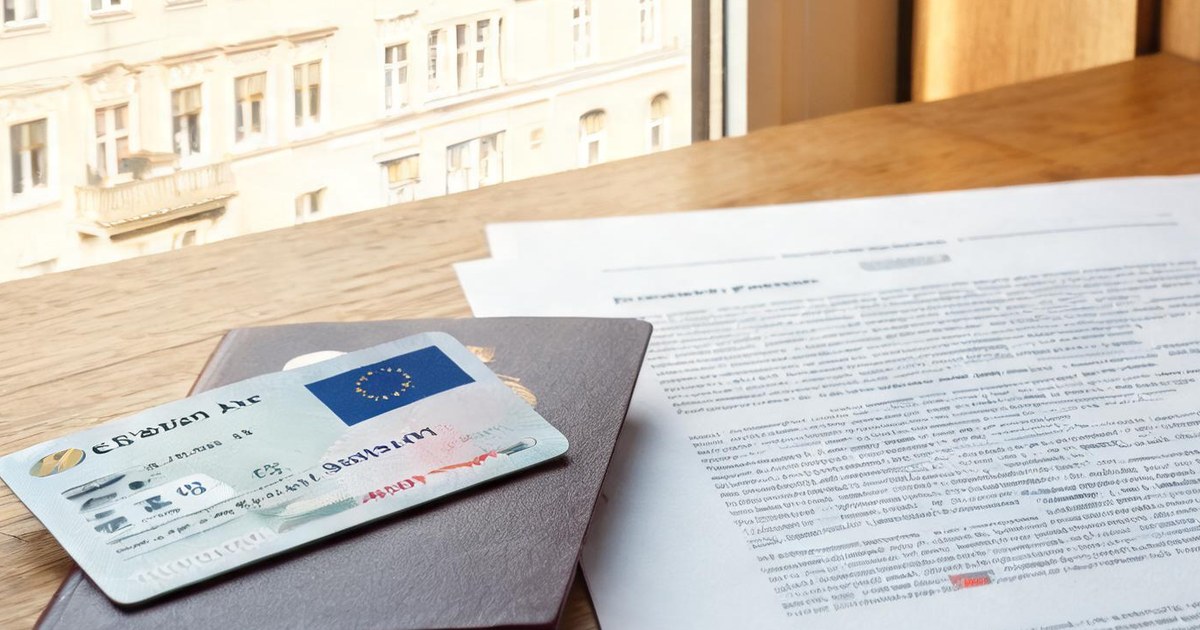
The key document is the Karte für subsidiär Schutzberechtigte — a grey card in the uniform EU residence permit design. According to oesterreich.gv.at, it confirms both lawful residence and the protection status, so it serves as your identity document in interviews. The first card is issued for one year, the first renewal runs for three years, and every later renewal for five. Renewals are subject to fees, and the application goes to your regional BFA office.
A complete application pack looks like this:
- Karte für subsidiär Schutzberechtigte — proves the status and free labour market access;
- a national passport or the Fremdenpass — your travel and identity document;
- optionally, the AMS confirmation of exemption from the employment act, if the employer asks for it;
- a Sozialversicherungsnummer (social insurance number) — assigned automatically at your first employment, together with the e-card.
The employer must conclude a written contract and register you with social insurance before your first working day. Refusing to hire someone because of the protection status is not allowed — equal treatment applies. If the card is lost or stolen, a replacement is issued by BFA for a fee; until it arrives, the status decision itself proves your right to work.
Registering with AMS and entitlement to benefits
AMS registration as a job seeker is voluntary but strongly recommended. The Chamber of Labour advises registering at your regional AMS office as soon as the status is granted: a counsellor helps with the CV, German courses and recognition of foreign diplomas. As the Vienna Chamber of Labour notes, AMS supports the job search regardless of whether you have already earned a benefit entitlement.
Arbeitslosengeld (unemployment benefit) requires contributions: as a rule at least 12 months of insured employment in Austria, or 6 months for people under 25. Your first job is therefore also the foundation of your future safety net.
One obligation is compulsory: the Integrationsjahr (integration year). According to the Chamber of Labour, subsidiary protection holders must participate — German language, occupational orientation and application training. Take course bookings and AMS invitations seriously: skipping integration measures affects both status renewals and social benefits. If no job materialises at first, temporary support can come through Mindestsicherung social assistance — but its rules are tightly linked to active cooperation with the employment service.
Self-employment and your own business
Self-employment (Selbstständigkeit) is allowed without restrictions. The employment act for foreign nationals only regulates dependent employment — freelance contracts and own businesses fall outside its scope entirely. You can work as a freie Dienstnehmerin (freelance contractor), take on project contracts or found a company.
For licensed crafts and trade, you need a Gewerbeschein (trade licence). The key requirement of the Trade Act is habitual residence in Austria — and the subsidiary protection card proves exactly that. The full registration path, SVS (self-employed insurance) rates and tax specifics are covered in our article on residence permits for the self-employed — including how a freelancer differs from a Gewerbe holder.
Do the maths first: the self-employed pay their own insurance contributions and income tax prepayments, and there is no paid leave or sick pay. For a first job in Austria, an employment contract is usually the better deal, while self-employment makes sense as an addition to a stable income.
Family reunification and work for relatives
Family rules are stricter than work rules. Under the post-GEAS framework described in detail by asylkoordination österreich, a subsidiary protection holder may apply for family reunification only 2 years after the status was granted. Applications are limited to the Kernfamilie (nuclear family): spouse, unmarried minor children and the parents of a minor holder.
The conditions are material. In 2026 this means a net income from €2,064.12 for a couple plus €201.88 per child, adequately sized housing and health insurance. Austria-wide, the annual quota is 314 places, as ORF reports: once the quota is exhausted, applications wait for the next year.
The good news on work: relatives who arrive receive a Rot-Weiß-Rot Karte plus — a title that explicitly includes the right to employment. A spouse and adult children can therefore work on the same terms as the status holder, without AMS permits. Use the two-year wait to prepare documents: translated certificates, proof of kinship, income statements — our article on Familienbeihilfe for holders of subsidiary protection lists similar rules for child benefits.
There is also an alternative route — a joint application. If relatives have not yet left the country of origin, it is sometimes simpler to open their own protection application: in a family procedure, as [oesterreich.gv.at) explains, a family member receives the same protection status as the principal applicant. The rule covers spouses and minor children, and each family member still gets an individual decision. Weighing reunification against a joint application is best done with a legal adviser: timelines and risks differ.
Free access to the labour market is a necessary but not sufficient condition for employment: without working-level German and recognition of qualifications, many status holders remain below their skill level.
— analytical conclusion by asylkoordination österreich on the integration reform
What happens to your job if the status is revoked
The status can be revoked (Entzug) — and that hits employment directly. According to [oesterreich.gv.at), the grounds are: the threat in the country of origin has ceased, the person has acquired another citizenship, committed a serious crime, concealed material facts in the application, or left the home country to escape prosecution. The procedural rules sit in § 9 AsylG: where criminal grounds apply, revocation proceedings must be opened.
Revocation automatically withdraws the right of residence — the card goes back to the authority. Free labour market access rests on the status, so losing it also ends the right to permit-free work. Three scenarios follow: removal, Duldung (temporary toleration of stay) without a work entitlement, or a switch to another residence title if one is available under the general rules.
The positive scenario is more reliable: after 5 years of residence the holder may apply for a Daueraufenthalt – EU (EU long-term residence). This title is independent of the protection status and keeps employment unrestricted, even if the situation in the country of origin improves one day. Practice shows that the earlier you start the language and collect integration evidence, the smoother both renewals and the later switch become.

Your rights at the workplace
An employment contract held by a person with subsidiary protection is legally identical to any other. The collective agreement, regulated working hours, paid leave, sick pay and pension contributions all apply. Paying below the collective rate “because of the status” is not permitted — the Chamber of Labour offers free consultations, and membership is automatic for every employee.
Watch for two typical traps. The first is a Werkvertrag (contract for work) used where dependent employment is the reality: no social insurance, no leave. The second is undeclared cash work: it destroys the contribution record for benefits and pensions, and the risk falls on the employee too. Neither scheme is necessary with a protection status — you may work legally in any industry without a single permit.
Another shield is pay equality. Collective agreement requirements bind everyone in the industry, regardless of nationality or residence title. If your payslip systematically falls below the tariff rate, that is a violation you can document: the Chamber of Labour will audit the calculations, and wage arrears are often recovered without court action. Discrimination in hiring — a refusal “because of the passport” at equal qualification — is handled by the equality body; the complaint is free, and part of the burden of explanation shifts to the employer.
Frequently Asked Questions
Do subsidiary protection holders need a work permit? No. People with international protection are exempt from the employment act for foreign nationals; no AMS permit is needed for hiring or for changing employers. AMS issues a written confirmation for employers on request.
Can someone with subsidiary protection start a business or freelance? Yes. Self-employment falls outside the employment act: freelance contracts, project work and own companies are all allowed. Licensed activities need a Gewerbeschein, for which lawful residence in Austria suffices.
When can the family come, and can relatives work? Reunification applications open 2 years after the status was granted — for spouses, minor children and the parents of a minor. Confirmed income, adequate housing and insurance are required. Relatives arriving under reunification receive a Rot-Weiß-Rot Karte plus with the right to work.
What happens to work if the status is revoked? Free employment ends with the status. What follows depends on the authority’s decision: removal, tolerated stay without work entitlement, or a switch to another residence title. The Daueraufenthalt – EU obtained after 5 years is independent of the status.
Are there restrictions by profession or region? No. Any industry in any Austrian province is open, full-time or part-time. Pay and conditions follow the industry collective agreement, not the holder’s status.
Is there any benefit if a job does not materialise at first? Unemployment benefit requires 12 months of insured employment (6 for under-25s). Before that, Mindestsicherung and basic support can help, but they demand active cooperation with AMS: refusing suitable vacancies or courses quickly leads to benefit cuts.
What to do first
Subsidiary protection in Austria is a genuine start on the labour market: no permits, no tests, no waiting. While the status runs, work, bank your contribution record and your German — the only two assets that turn formal freedom into real offers. Plan in three steps:
- Register with AMS and complete the Integrationsjahr — it unlocks courses and qualification programmes.
- Assemble your documents: the status card, passport or Fremdenpass, the AMS confirmation for employers.
- Count the horizon: 5 years to Daueraufenthalt – EU and 10 years to naturalisation eligibility — the earlier the German starts, the faster both deadlines become reality.
The full legalisation roadmap with steps, deadlines and documents is in our overview of residence permits in Austria. And to keep up with changing hiring rules and benefits, subscribe to the how2austria newsletter — key migration law updates reach subscribers first, short and free of legal jargon.
Stay Up to Date with the Latest Austrian News
The week's top stories — news, guides, and insights about life in Austria. Every Sunday in your inbox.