
Residence Permit Through Marriage in Austria: Aufenthaltstitel nach Heirat Guide 2026
Residence Permit Through Marriage in Austria: Aufenthaltstitel nach Heirat Guide 2026 Residence permit through marriage in Austria — complete 2026 guide to Familienzusammenführung: requirements, documents, timeline, costs and work rights for Topics: Migration, Residence Permits, Citizenship.
A residence permit through marriage in Austria is one of the most reliable paths for spouses of Austrian citizens and third-country residents. Known legally as Familienzusammenführung (family reunification), it lets you live, work and access health insurance from day one. Unlike work-based permits, you do not need to collect points or prove a shortage occupation.
This guide explains who qualifies for an Aufenthaltstitel (residence permit) through marriage, the 2026 income and housing thresholds, which documents to prepare and where to apply — at the embassy or at MA 35 (Vienna’s immigration office). You will also learn processing times, fees, work rights, renewal to Daueraufenthalt – EU and how Austria checks for Scheinehe (sham marriage). A checklist and FAQ close the article.
What a residence permit through marriage is and who qualifies
A residence permit through marriage in Austria is an Aufenthaltstitel (residence permit) issued for Familienzusammenführung (family reunification) to spouses of Austrian citizens, EU/EEA citizens and third-country nationals with permanent residence. According to oesterreich.gv.at — family reunification, spouses aged 21+ whose marriage is officially registered and whose sponsoring spouse legally resides in Austria are entitled to apply. This permit is not tied to an employer and grants free access to the labour market.
Two legal tracks exist. If your spouse is an Austrian citizen, you receive an Aufenthaltstitel Familienangehöriger under § 47 NAG (Settlement and Residence Act). If your spouse is a third-country national with a Rot-Weiß-Rot – Karte Plus or Daueraufenthalt – EU, you receive a Niederlassungsbewilligung — Angehöriger. Both are credit-card-sized cards valid for 12 months and renewable. According to BMI — residence statistics 2024, more than 17,400 residence permits in 2024 were issued for family reasons — 28% of all first issuances.
Same-sex spouses have identical rights: a registered partnership (eingetragene Partnerschaft) is treated like marriage. For context on equal rights, see our guide to same-sex marriage in Austria. If you are still weighing options, compare family reunification with work-based routes in our overview of residence permit types in Austria.
Legal basis — Familienzusammenführung under NAG and EU law
Familienzusammenführung (family reunification) in Austria is governed by the Niederlassungs- und Aufenthaltsgesetz (NAG) and EU Directive 2003/86/EC. According to RIS — NAG § 47 Family Reunification, the spouse of a person legally residing in Austria is entitled to a residence permit if the sponsor shows sufficient income, housing and insurance and the marriage is not deemed sham. The law requires both spouses to share a household in Austria.
A key feature is the quota. Spouses of third-country nationals fall under an annual quota for Niederlassungsbewilligung set by the federal government. Spouses of Austrian and EU citizens are quota-exempt — applications are processed outside the quota and therefore faster. As migration.gv.at — Family Reunification reports, the average waiting time outside the quota in 2025 was 3–4 months, versus 5–8 months inside the quota.
A separate card exists for spouses of EEA/Swiss citizens: the Aufenthaltskarte für Angehörige eines EWR-Bürgers. It is issued faster and cheaper with similar rights. If your spouse is a German or other EU citizen living in Vienna, MA 35 will issue this card. For forms and filing details, see our guide to applying for a residence permit — forms.
Requirements for the marriage and both spouses
To obtain a residence permit through marriage in Austria, both spouses must meet clear criteria. The marriage must be valid and registered — a church ceremony without civil registration does not count. Both spouses must be at least 21 at the time of application (if the Austrian spouse is 21+ and the other is 18–21, decisions are made case by case). The sponsoring spouse needs a Meldezettel (registration of residence) in Austria.
The sponsor must prove financial means. According to oesterreich.gv.at — Means of subsistence, the 2026 minimum net income for a family is €1,218.96 for one person + €187.73 for the spouse + €188.45 per child (Ausgleichszulagen-Richtsatz 2026). Income is assessed after deducting rent and loans. Salaries, Karenz (parental leave), pensions, scholarships or proven self-employment income count — Mindestsicherung (minimum welfare) does not.
Housing must be adequate: at least 20 m² for the couple + 10 m² per additional person. The rental contract (Mietvertrag) must be in the sponsor’s name and valid for at least 3 months after filing. Health insurance is mandatory: the arriving spouse must be covered by ÖGK (Austrian Health Insurance Fund) via family co-insurance or a private policy covering €30,000+. Without insurance, the permit will be refused — a frequent ground for denial.
Document checklist for a marriage-based permit
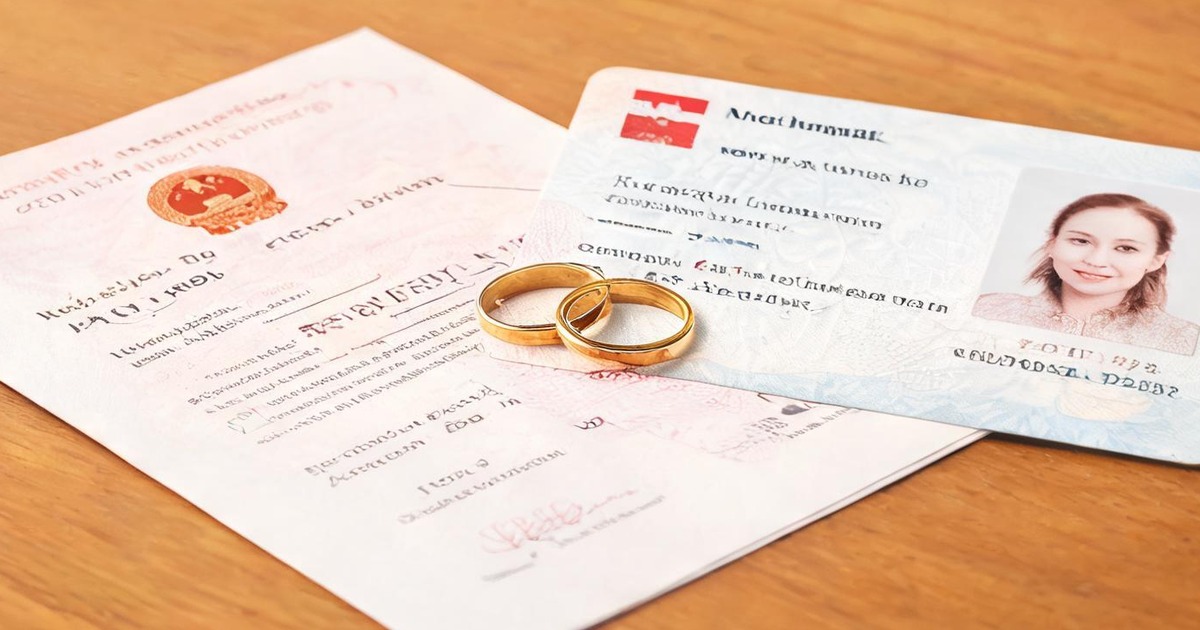
The full checklist for an Aufenthaltstitel nach Heirat (residence permit through marriage) depends on the sponsor’s status, but the core set is the same. All foreign documents need an apostille and a translation by a court-certified translator (gerichtlich beeideter Dolmetscher) into German. As wien.gv.at — MA 35 Family Reunification notes, incomplete files caused 35% of returns in Vienna in 2024.
Core checklist for the applicant spouse:
- Passport valid at least 12 months after filing
- Marriage certificate (Heiratsurkunde) with apostille, not older than 6 months
- Birth certificate of the applicant
- Police clearance from the country of residence (not older than 3 months)
- German A1 proof (Goethe, ÖSD, Telc — A1 for the first permit, A2 for renewal)
- Sponsor’s passport + Meldezettel and Mietvertrag
- Income proof for the last 3 months (payslips, bank statements)
- Insurance proof (ÖGK registration or private policy)
- 2 photos 35×45 mm (ICAO standard)
Spouses of Austrian citizens additionally need a Staatsbürgerschaftsnachweis (proof of citizenship). Spouses of third-country residents need a copy of their Aufenthaltstitel and quota confirmation. If you have children, add their birth certificates and custody proof. Download forms early — see our article on the extension form for residence permits.
Step-by-step process — where and how to apply
You can apply for a residence permit through marriage in Austria either from abroad via the embassy or from inside Austria at MA 35 if you are legally present. According to BMI — First residence title, the general rule is to apply abroad at the Austrian embassy, but spouses of Austrians and holders of a visa D may apply inside Austria. Breaching this rule is a common ground for refusal.
Step 1. Marry and obtain the Heiratsurkunde. If married abroad, legalise it with an apostille. Marriages in Austria are registered by the Standesamt — the entry appears in the ZPR (central civil register) within 2 weeks.
Step 2. Collect and translate documents. Use a court-certified translator — plain translations are rejected. Copy all passport pages.
Step 3. Book an appointment. In Vienna, book MA 35 online (waiting time 4–7 weeks in 2026). Abroad, book at the Austrian embassy. No walk-ins are accepted.
Step 4. File and give biometrics. You provide fingerprints, a photo and a signature. Filing fee is €160 (card or payment slip). You receive a Bestätigung über die Antragstellung (confirmation of filing) — it does not authorise work until the card is issued.
Step 5. Examination. The authority checks income, housing, authenticity of the marriage and public-order criteria. A home inspection (Hauskontrolle) or interview may follow. Duration: 3–6 months.
Step 6. Collect the card. After approval you are invited to pick it up in person. The card is valid for 12 months and includes a biometric chip. From that day you may work without extra permission — the card states freier Zugang zum Arbeitsmarkt.
If you are in Austria visa-free, do not file inland without advice — it is risky. The correct path is explained in our residence permit application guide.
Timeline, costs and quotas in 2026
Processing time and cost for a residence permit through marriage in Austria in 2026 depend on the sponsor’s category. Spouses of Austrian and EU citizens are processed faster because they are quota-exempt. Spouses of third-country residents face the annual quota for Niederlassungsbewilligung.
According to oesterreich.gv.at — Residence title costs, official fees in 2026 are:
| Category | Filing | Card issuance | Renewal |
|---|---|---|---|
| Spouse of Austrian (§ 47 NAG) | €160 | €20 | €160 |
| Spouse of third-country resident | €160 | €20 | €160 |
| Aufenthaltskarte EWR family member | €60 | €0 | €60 |
Extra costs: translations €25–50 per page, apostille €15–40 per document, German A1 certificate €150–200, insurance €60–120 per month if private. Total starter budget is €500–900 excluding embassy travel.
Waiting times per wien.gv.at — MA 35 Waiting Times in 2026: quota-exempt (Austrian/EU) — 8–16 weeks, quota-based (third-country) — 5–8 months. Vienna’s 2025 quota was 2,150 places, 68% of which went to family reunification. If the quota is exhausted, the application rolls to the next year — so file in January–March while the quota is fresh.

Rights with a marriage-based permit — work, language, benefits
A residence permit through marriage in Austria offers the strongest rights among family permits. The key advantage is free access to the labour market from day one. The card bears the note “Freier Zugang zum Arbeitsmarkt” — you need no Beschäftigungsbewilligung (work permit) and your employer files no extra paperwork. You can work full-time or part-time, change employers and register with AMS (Public Employment Service).
Health insurance is included. Through your spouse you join the ÖGK (Austrian Health Insurance Fund) via family co-insurance — free if your spouse is insured. It covers doctors, hospitals and the e-card (electronic health card). Without it, you cannot renew a residence permit — this is a requirement under § 11 NAG.
Language and integration are next. The first permit needs A1, renewal needs A2, and Daueraufenthalt – EU needs B1 plus the Integrationsvereinbarung module. The ÖIF (Austrian Integration Fund) partly funds courses — a €750 voucher for B1. As ÖIF — Integration Agreement 2025 reports, 73% of family migrants passed A2 at the first attempt in 2024.
Education and social support follow. Children get a school place and Familienbeihilfe (family allowance €180–190 per child per month), spouses can attend AMS courses and receive Kinderbetreuungsgeld. For more on family benefits, see our guide to family allowance in Austria. After 5 years of cohabitation you can obtain Daueraufenthalt – EU — permanent EU residence.
Renewal, Daueraufenthalt – EU and the path to citizenship
Renewing a residence permit through marriage in Austria is required annually for the first 5 years. Apply no later than 4 weeks before expiry at the same MA 35 or Bezirkshauptmannschaft (district authority). Even a one-day delay makes your stay illegal — see § 21 NAG. Per wien.gv.at — Extension of Family Reunification, renewal needs current payslips for 3 months, a valid Mietvertrag and an A2 certificate (from year two).
After 5 years of uninterrupted cohabitation and B1 you qualify for Daueraufenthalt – EU — permanent, EU-wide residence. Conditions: 5 years without gaps, income above the Richtsatz, insurance, B1 and no criminal record. The status needs no annual renewal — just a card replacement every 5 years for €28. For the full procedure, see our article on extending your residence permit — timing and documents.
The route to Staatsbürgerschaft (citizenship) through marriage is shorter but not automatic. According to oesterreich.gv.at — Citizenship through Marriage, the spouse of an Austrian can apply after 6 years of residence in Austria, including 5 years of marriage and joint household, with B1 and renunciation of prior citizenship (Austria generally prohibits dual citizenship). For spouses of non-Austrians the general period is 10 years (including 5 years with Daueraufenthalt – EU). Proven sustained integration (B2 + volunteering) can reduce the period to 6 years.
Marriage to an Austrian citizen provides one of the most stable residence permits, but it does not exempt you from integration: language, income and cohabitation are checked every year, and divorce before five years can end your right to stay.
— Mag. Katharina Berger, Immigration Lawyer, Vienna
Sham-marriage checks — how Austria detects Scheinehe
Scheinehe (sham marriage) is the leading ground for refusal of family permits in Austria. According to BMI — Aliens Police Report 2024, 412 family-reunification applications were rejected for suspected Scheinehe in 2024 — 4.1% of all family filings. Checks can include separate interviews, a home visit and analysis of messages.
Red flags for MA 35 and the Landespolizeidirektion:
- No common language and no long-term photos or messages
- Separate residences — different Meldezettel, no shared belongings at the flat
- Large age gap without a relationship history (more than 20 years)
- Marriage soon after meeting (under 3 months) followed by a quick permit application
- Contradictory interviews — different answers about daily life, habits or relatives
Interviews are held separately: who makes breakfast, where the toothbrush is, what the mother-in-law’s name is. If answers diverge by >30%, a second check is ordered. Penalties for Scheinehe are serious: cancellation of the permit, an entry ban for up to 5 years and a criminal case under § 117 FPG (fine up to €3,600 or imprisonment). Even facilitation of a sham marriage is punishable.
To pass smoothly, keep evidence of shared life: joint photos over 12+ months, tickets, messages, a joint rental contract, a shared bank account and insurance. Attach 5–10 photos from different periods and a one-page Beziehungsgeschichte (relationship history) — this greatly reduces follow-up questions.
Divorce, separation and domestic violence — what happens to the permit
Family-based residence status is tied to the marriage and cohabitation for the first 5 years. If the marriage ends earlier, you may lose the right to stay — but important exceptions exist. Under RIS — NAG § 27 Loss of Residence Right, divorce before 5 years does not automatically extend the permit; you must prove an independent ground (work, study).
Divorce before 5 years: if you were married in Austria for less than 5 years and divorce, you can retain the permit if: (a) the marriage lasted at least 2 years in Austria and you hold A2, or (b) you have a job above the Richtsatz and switch to a Rot-Weiß-Rot – Karte or EU Blue Card. Without this, you must leave.
Separation (Getrenntleben): if you live apart but are not divorced, MA 35 may refuse renewal because the gemeinsamer Haushalt (joint household) condition is breached. You must report any move within 3 days (Meldepflicht) — hiding separation is impossible, as the ZMR (central residence register) is checked.
Domestic violence — exception: if you are a victim of domestic violence, the permit is retained regardless of your spouse’s consent. Per oesterreich.gv.at — Protection against violence and residence, a certificate from a Gewaltschutzzentrum (violence protection centre), Frauenhaus or a court barring order (Betretungsverbot) suffices. In 2024, 89 women retained their permits on this ground. Call Frauenhelpline 0800 222 555 — the call is free and confidential.
How a marriage-based permit compares to other family permits
Not all family permits are equal. The right title affects speed, work access and the path to permanent residence. The table compares the three main family routes as of 2026 — compiled from oesterreich.gv.at and migration.gv.at.
| Criterion | Spouse of Austrian (§ 47 NAG) | Spouse of third-country resident | EWR family member (spouse of EU citizen) |
|---|---|---|---|
| Quota | None | Yes (annual) | None |
| Processing time | 8–16 weeks | 5–8 months | 4–8 weeks |
| Work access | Free from day 1 | Free from day 1 | Free from day 1 |
| German at start | A1 | A1 | No requirement |
| Renewal | Yearly, then Daueraufenthalt – EU | Yearly, then Daueraufenthalt – EU | Every 5 years |
| Path to citizenship | 6 years in marriage | 10 years (general) | 6–10 years |
In short: the fastest and most favourable path is when the sponsor is an Austrian or EU citizen. If your spouse holds a Rot-Weiß-Rot – Karte, expect a quota and file early in the year. For students with an Aufenthaltsbewilligung Student, family reunification is possible only after 2 years of residence and above-threshold income — a separate, complex procedure (see student residence permit).
Common mistakes when applying through marriage
Even genuine marriages are refused over formalities. According to MA 35 data for 2024, 42% of refusals for family permits were due not to suspected Scheinehe but to paperwork and income errors. Check yourself before filing.
Mistake 1 — income below the Richtsatz. Net income after rent counts. Example: gross €1,700 → net €1,350, rent €800 → €550 left, but €1,407 for two is required → refusal. Fix: add savings proof (Sparbuch with €15,000+) or a Haftungserklärung (liability declaration) from a relative with income.
Mistake 2 — expired certificates. A police clearance older than 3 months or a marriage certificate older than 6 months means an automatic return. Order them 4 weeks before filing, not half a year earlier.
Mistake 3 — wrong translation. A translation without the seal of a gerichtlich beeideter Dolmetscher is rejected. The list of sworn translators is on the BMI and Justiz websites. Cost is €35–50 per page but saves months.
Mistake 4 — filing at the wrong place. Inland filing while on visa-free stay without a right to an Inlandsantrag → refusal and departure. Rule: if you entered on a C visa or visa-free, file via the embassy, except for spouses of Austrians (§ 21 para 2 NAG). Clarify with MA 35 in advance.
Mistake 5 — missing Meldezettel and insurance. No registration or family insurance taken out after filing → refusal. Register at the Meldeservice within 3 days of arrival and arrange ÖGK before filing.
Frequently Asked Questions
Can I get a residence permit through marriage if my spouse is not Austrian but holds a Rot-Weiß-Rot – Karte?
Yes, but subject to quota. A spouse with a Rot-Weiß-Rot – Karte Plus or Daueraufenthalt – EU can sponsor a spouse under a Niederlassungsbewilligung — Angehöriger. Requirements are the same — income, housing, A1, insurance — but the application falls under the annual quota. File in January–March while the quota is fresh and expect 5–8 months. After 5 years of cohabitation you receive Daueraufenthalt – EU regardless of the sponsor’s status.
Do I need German for a marriage-based residence permit in Austria?
Yes, at least A1 at first filing — without a Goethe/ÖSD/Telc certificate the application will not be accepted. Renewal after a year requires A2, and Daueraufenthalt – EU requires B1. Exception: spouses of EEA citizens (Aufenthaltskarte) have no language requirement at the start, but B1 is still needed for permanent residence. The ÖIF partly reimburses courses — a voucher up to €750.
Can I work immediately after getting a residence permit through marriage?
Yes, from the day the card is issued. The card states “Freier Zugang zum Arbeitsmarkt” — full access without employer permission. You can work for any employer, change jobs, register with AMS and claim unemployment benefits after 52 weeks of work. You may not work before the card is issued — even if the application is pending.
What happens to my permit if we divorce before permanent residence?
If divorce occurs after 5 years of cohabitation in Austria, you keep the right to Daueraufenthalt – EU and can stay. If before 5 years, the right is lost, but you can switch to another permit (work, study) if you find a job above the Richtsatz and hold A2. In proven domestic violence cases the permit is retained regardless of duration — contact a Gewaltschutzzentrum or call 0800 222 555.
Conclusion — checklist for a residence permit through marriage in Austria
A residence permit through marriage in Austria is an Aufenthaltstitel via Familienzusammenführung that lets spouses of Austrian, EU and third-country residents live and work from day one. The core conditions are a valid marriage, age 21+, income above €1,407 for two, housing of at least 20 m², ÖGK insurance and German A1. Filing is via the embassy or MA 35, takes 2–8 months, costs €160–180, and the card is valid for 12 months with annual renewal until Daueraufenthalt – EU after 5 years.
Checklist before filing:
- Marriage registered, Heiratsurkunde with apostille on hand (not older than 6 months)
- Both spouses 21+, Meldezettel and Mietvertrag for 20 m²+ available
- Income above Richtsatz 2026 — Gehaltszettel for 3 months + Kontoauszug collected
- ÖGK family insurance arranged and A1 certificate obtained
- All documents translated by a sworn translator, police clearance fresh
- Appointment at MA 35 or the embassy booked, ICAO photos 35×45 ready
- Beziehungsgeschichte and 5–10 joint photos prepared for the Scheinehe check
Start by checking income and booking an appointment — these take the longest. And to stay on top of quota and language changes, subscribe to our newsletter — we cover new NAG rules and MA 35 practice every month. Good luck with your application and a speedy reunion in Austria!
Stay Up to Date with the Latest Austrian News
The week's top stories — news, guides, and insights about life in Austria. Every Sunday in your inbox.