Motorcycle License in Austria: Category A Step by Step
Motorcycle License in Austria: Category A Step by Step Motorcycle license in Austria: age limits, costs, training and exams for A1, A2 and A. How to exchange a foreign license, use Stufenzugang and save money. Topics: Daily Life, Transport.
Getting a motorcycle license in Austria means navigating a three-tier system that differs from most other countries. Instead of one category, the law defines three classes — A1, A2 and A — each with its own minimum age, power limits and training route. Understanding the difference early saves both time and money.
This guide explains everything you need: what each motorcycle class allows, the exact age requirements, how much a category A license costs in 2026, how training and exams work, how to exchange a foreign license, and how to get the unrestricted A class as early as age 20 through the Stufenzugang programme. All figures are checked against oesterreich.gv.at, ÖAMTC and current driving school price lists.
Three Classes: A1, A2 and A Explained
Austrian law splits motorcycles into three categories with different power restrictions. A1 covers light motorcycles up to 125 cc and 11 kW (15 hp), A2 covers machines up to 35 kW (48 hp), and A allows motorcycles of any power.
| Class | Minimum age | Restrictions | What you can ride |
|---|---|---|---|
| A1 | 16 years | up to 125 cc, up to 11 kW | Light motorcycles, trikes up to 15 kW |
| A2 | 18 years | up to 35 kW, up to 0.2 kW/kg | Mid-range motorcycles |
| A | 24 years (direct), 20 years (Stufenzugang) | none | Any motorcycle, includes A1, A2 and AM |
Holding class A automatically includes the right to ride A1, A2 and AM (mopeds). Pass the exam once for the big class and you cover every motorcycle category at once. As ÖAMTC explains, class A also covers three-wheeled vehicles above 15 kW.
Minimum Age: When You Can Start
Age is the main filter on the road to a motorcycle license in Austria. You may begin training at a driving school six months before reaching the minimum age, but the practical exam only becomes possible on your birthday. The rules are set in the Führerscheingesetz (FSG) and were updated on 1 January 2026, according to oesterreich.gv.at.
- A1 — exam at 16, training from 15.5.
- A2 — exam at 18, training from 17.5. Exception: if you take the L17 car programme simultaneously, training can start at 16.
- A — direct access at 24, training from 23.5.
- A via Stufenzugang — at 20, after two years of holding A2.
Minors additionally need written consent from a legal guardian — without it, the driving school will not accept the application. Age rules apply equally to foreigners and citizens: FSG makes no distinction based on nationality.
How Much a Motorcycle License Costs in 2026
The full budget for a category A motorcycle license in Austria ranges from €1,700 to €2,500. The final price depends on the driving school, extra lessons and whether you already hold a category B license. The gap between the most expensive and cheapest school reaches €500–600, so comparing price lists before enrolling is worth the effort.
A typical cost breakdown (based on driving school data and Allianz):
| Cost item | Amount |
|---|---|
| Training package (theory + 14 practical lessons) | €900 – €1,350 |
| Medical certificate (ärztliches Gutachten) | €35 |
| First aid course (if no category B) | €70 – €80 |
| Study materials | €50 |
| Government issue fee | €138 – €161 |
| Theory exam | €150 |
| Practical exam | €180 |
| Fahrsicherheitstraining (mandatory safety training) | €250 |
| Perfektionsfahrt (follow-up ride) | €200 |
For example, Vienna’s Fahrschulen Rainer sells the class A package for €1,349, and €1,529 for candidates over 39 (who need 12 lessons instead of 10). Total costs are highest for beginners without a category B: they must complete the extended Grundwissen theory course.
If you already hold A2, upgrading to A via Stufenzugang costs significantly less — €300 to €400 — because the full course is not required. More details in the dedicated section below. Motorcycle licenses are also considerably cheaper than car licenses: we compared category B prices across the border in our Austria vs Germany cost analysis.
Training: What the Course Looks Like
Training for class A in Austria consists of a theoretical and a practical part. Beginners without a category B license must complete the full theory course: 6 specialist sessions plus 20 Grundwissen sessions (general knowledge). Holders of category B only take the 6 specialist sessions.
The practical part is 14 lessons of 50 minutes: 4 on the training ground (basic control, slalom, emergency braking) and 10 in real traffic. Candidates over 39 get 16 lessons: 4 on the ground and 12 on the road. As Fahrschule Sommer notes, the price includes all legally required lessons.
Before lessons start you need a set of documents: a valid passport or ID, Meldezettel (residence registration), a 35×45 mm photo, a medical certificate (no older than 18 months) and a first aid course certificate. Without these papers the driving school cannot open your student file in the system.
Exams: Theory and Practical on a Motorcycle
The theory exam is computer-based, taken in front of an examiner. Questions are in German, with English options for foreigners, and answers are scored automatically. It costs about €150, and retakes are paid separately.
The practical exam lasts 25–35 minutes and is taken on a motorcycle of the class you are applying for: for A, a machine with at least 44 kW. First come ground exercises (moving off, figure-eight, obstacle avoidance, emergency braking), then a ride through city traffic. Mistakes with right-of-way and at intersections almost always mean a retake, as Vienna police remind applicants.
After passing you receive a temporary permit valid for 4 weeks, and the plastic card arrives by post once the government fee is paid. From this moment the probationary period starts — details in a separate section. If you plan to ride on motorways often, also check the general driving rules in Austria — speed limits, vignette and seasonal restrictions apply to motorcyclists too.
Stufenzugang: Category A at Age 20
The Austrian system lets you get the unrestricted class A four years earlier than the direct route. The so-called Stufenzugang (step-by-step access) works like this: obtain A2 at 18, ride for two years, then upgrade to A — at age 20.
The upgrade conditions are simple: two years of holding A2, a completed second training phase and 7 practical lessons (50 minutes each) or a practical exam — your choice. No theory exam is needed for the upgrade, as ÖAMTC confirms.
The upgrade costs €300–400 instead of €1,700–2,500 for a full course. Many riders choose this path: it is cheaper and gives two years to get used to a mid-range machine before moving to unrestricted power.
License Validity and Renewal
Austrian motorcycle licenses are EU-standard plastic cards issued for 15 years. When they expire, renewal is simple: no exams, just an application, a fee of about €60–90 and a fresh medical certificate if the authority requires one.
The medical certificate is valid 18 months — plan accordingly: if you get it early and training drags on, you may have to pay €35 for a new one. Moving within Austria does not require re-registering your license, unlike some other countries.
From 19 January 2033, only new-style plastic cards will be valid in Austria and the whole EU. Old paper and early cardboard licenses must be exchanged before that date — the process takes a few weeks and costs €73–90, as oesterreich.gv.at explains for moped licenses.
How to Save on a Motorcycle License
You can cut the cost of a category A license by €300–500 with a systematic approach. Proven strategies:
- Compare driving schools. Prices for the same package differ by up to €500–600. Arbeiterkammer publishes regular price checks — current data for Upper Austria is in the AK survey. Look for schools where exam retakes are included or the practice ground is free.
- Combine with category B. If you do not have a car license yet, take A and B together — schools discount combined packages, and theory and the second phase overlap.
- Skip unnecessary lessons. The standard 14-lesson package is usually enough with disciplined ground practice. Buy extra lessons at €70–140 selectively, just before the exam.
- Book the second phase upfront. Perfektionsfahrt and Fahrsicherheitstraining are mandatory — cheaper as part of a package than separately after getting the license.
- Consider Stufenzugang or Code 111. For young riders the step-by-step path saves up to €1,000 compared with a full course at 24, and for experienced drivers Code 111 at €265 is the cheapest entry into motorcycling.
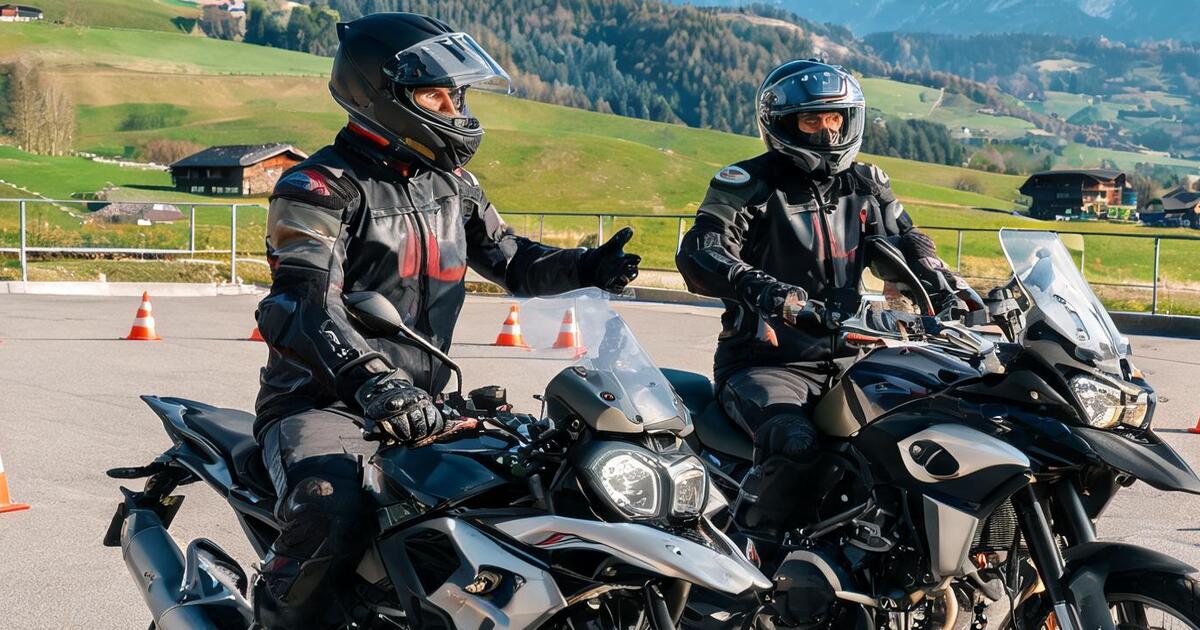
Code 111: Riding a 125cc Bike with a Car License
Good news for holders of a category B (car) license: in Austria you can legally ride a motorcycle up to 125 cc without taking any exams. You just complete a short course and get the Code 111 entry added to your license.
Requirements: at least 5 years of uninterrupted category B, age 25 or older, and no active probationary period. The course takes 6 practical sessions of 90 minutes and costs about €265, according to the Fahrschule Sommer price list. Afterwards the number 111 appears on your license, permitting light motorcycles.
One caveat: Code 111 is only recognised in Austria and Germany and does not replace a full A1 class when travelling to other EU countries. If you plan to cross borders on a 125cc bike, you will still need to pass the A1 exam. By the way, traffic violations in Austria are enforced strictly — see our roundup of fines newcomers overlook to avoid surprises.
Exchanging a Foreign License for Category A
If you already hold a motorcycle license from another country, Austria offers two scenarios. Licenses issued in EU/EEA countries are recognised without exchange — you can ride on your existing document indefinitely. Licenses from outside the EU must be exchanged within 6 months of registering your residence, otherwise they lose validity, oesterreich.gv.at warns.
The exchange process: apply at the Führerscheinbehörde (police licensing office) with your passport, Meldezettel, photo and original license. The fee is €90 since 1 July 2025. The key point: for category A from most non-EU countries a practical exam on a motorcycle is required — the theory is credited automatically. Exceptions are countries whose licenses are fully recognised: Switzerland, Serbia, Montenegro, the UK and several others listed by ÖAMTC.
Probationary Period and the Second Training Phase
After obtaining any motorcycle license in Austria, a Probezeit (probationary period) begins — 3 years (until age 21 for A1). During this time the alcohol limit is almost zero at 0.1 per mille, and serious violations extend the period by a year with mandatory paid retraining. Note that the EU is tightening cross-border enforcement: the new EU rules on license suspension will share information between member states, so a suspension in one country will apply everywhere.
There is also a mandatory second training phase: within the first year you must complete a Perfektionsfahrt (follow-up ride with an instructor) and a Fahrsicherheitstraining (safe riding course) — the latter between 2 and 12 months after passing. These obligations cost €400–450 in total, already included in the budget above.
Austria vs Germany: Different Systems
Expats comparing the two countries are often surprised by how different the motorcycle licensing systems are. In Austria the three-tier structure with Stufenzugang is the standard, while Germany offers additional shortcuts like B196 for 125cc bikes and requires fewer compulsory lessons overall.
The price gap is the most visible difference. A full car license costs roughly twice as much in Austria as in Germany, and motorcycle training follows the same pattern — we analysed the price difference in detail in our article on driving license costs in Austria vs Germany. Austrian packages start around €1,200, German ones around €1,000, and the gap widens with mandatory extras such as the Fahrsicherheitstraining.
Practical implications for newcomers: if you already hold a license from another EU country, the fastest way to ride legally in Austria is to keep your existing license — exchange is not required. If you hold a German license, it is valid in Austria without any paperwork. Only when your license expires or you want the unrestricted A class from scratch does the Austrian system apply in full.
Safety: Motorcyclist Statistics in Austria
The statistics explain why the Austrian training system is so strict. According to Statistik Austria, in 2025 a total of 81 motorcyclists were killed on Austrian roads (83 the year before), and 4,584 were injured — 3% more than in 2024. Three quarters of the fatalities were men, and 42% of injured riders crashed alone, without another vehicle involved.
The most vulnerable age group is 20–29: they account for 22% of all injured motorcyclists. This is why the second training phase and the safety course are mandatory for every beginner regardless of age — the system is designed so that the first two years of independent riding happen under instructor supervision.
Motorcycles remain the riskiest mode of transport in Austria: fatality rates per kilometre are many times higher than in cars. That is why the legislator relies not on bans but on mandatory training and controlled early years of riding.
— Based on the Statistik Austria road accident report 2025
Frequently Asked Questions
Can I ride a 125cc motorcycle in Austria with a car license? Yes, under three conditions: at least 5 years of category B, age 25 or older, and completing the Code 111 course (6 sessions, ~€265). Without the 111 entry on your license, riding a motorcycle is treated as driving without a license.
What is the minimum age for a category A motorcycle license? Direct access to A opens at 24 (training from 23.5). Through Stufenzugang you can get it at 20, if you have held A2 for two years. A1 is available at 16, A2 at 18.
How much does a motorcycle license cost in Austria? A full category A course costs €1,700–€2,500 including training, exams, medical certificate, fees and mandatory safety courses. An upgrade from A2 to A via Stufenzugang costs €300–400.
Do I need an exam when exchanging a foreign license? For EU/EEA licenses — no exchange is needed at all. For non-EU licenses — yes, a practical exam is almost always required (theory is credited). Exceptions: Switzerland, Serbia, the UK and other fully recognised countries.
Can I take motorcycle training in English? Yes, major driving schools in Vienna and other cities offer theory in English. Practical lessons are one-on-one, and you can choose the instructor’s language when booking.
What to Do Next
Getting a category A motorcycle license in Austria is a predictable process if you follow the steps:
- Identify your tier: A1 (16+), A2 (18+) or straight A (24+).
- Compare prices at 3–4 driving schools — the gap can reach €500–600.
- Gather documents: passport, Meldezettel, medical certificate, first aid course.
- Book theory and practice — a full course takes 2–3 months.
- Pass the exams and budget for the second phase (€400–450).
- If you have 5+ years of category B, consider Code 111 as a budget alternative.
If you are planning a move to Austria and want to understand what other documents and permits you will need, subscribe to our newsletter, where we break down such topics in plain language.
Stay Up to Date with the Latest Austrian News
The week's top stories — news, guides, and insights about life in Austria. Every Sunday in your inbox.