ORF Fee Exemption in Austria: Who Qualifies and How to Apply
ORF Fee Exemption in Austria: Who Qualifies and How to Apply ORF fee exemption in Austria explained: 9 eligible groups, 2026 income limits, required documents and how to apply to OBS step by step, plus bonus benefits. Topics: Daily Life, Economy, Housing.
Every household in Austria pays the ORF-Beitrag (broadcasting fee for public TV and radio) - €15.30 per month, and in some federal states even more. What many residents do not know: the law allows you to be completely exempted from this payment. The ORF fee exemption in Austria is available to pensioners, unemployed people, students on state grants, recipients of Mindestsicherung (minimum income support) and several other groups. Beyond the fee itself, a single application unlocks four additional benefits, including a social electricity tariff starting April 1, 2026. This article covers: who qualifies for the ORF fee exemption, the 2026 income limits, which documents you need, and how to submit your application to OBS (ORF-Beitrags Service GmbH, the former GIS) without mistakes.
What the ORF-Beitrag is and who has to pay it
The ORF-Beitrag is a mandatory monthly fee that funds the public broadcaster ORF. Since 2024 it is collected by OBS (ORF-Beitrags Service GmbH), which replaced the old GIS (Gebühren Info Service). The fee is tied not to a person or the number of TVs but to an address: it is due for any home where at least one adult is registered with a Hauptwohnsitz (main place of residence).
According to the official OBS payment page, the base fee is €15.30 per month in all nine federal states. Four states add a Landesabgabe (state levy): the total is €18.40 in Tyrol, €19.90 in Burgenland and Carinthia, and €20.00 in Styria. You do not pay the ORF-Beitrag for a Nebenwohnsitz (secondary residence).
OBS receives registration data automatically from the ZMR (central residents register), so the payment request arrives on its own without any registration on your part. Payment is due once a year in advance; with SEPA-Lastschrift (direct debit) you can split it into 2 or 6 instalments. For a family this is a noticeable budget item: €183.60 per year in Vienna or €240.00 per year in Styria. That is exactly why checking your eligibility for the ORF fee exemption is worth ten minutes of your time.
Who qualifies for the ORF fee exemption
The ORF fee exemption is granted to members of legally defined Anspruchsgruppen (entitlement groups). According to the official OBS list, there are nine groups, each with its own documentary proof:
| Eligible group | Document that proves it |
|---|---|
| Unemployed | Current AMS benefit confirmation or decision |
| Deaf and hard of hearing | Disability ID with the relevant entry or a medical certificate |
| Recipients of the Kinderbetreuungsgeld supplement | Proof of the benefit payment |
| Adult apprentices (Lehrlinge) | Training contract and current pay statement |
| Minimum income recipients | Decision on Mindestsicherung or Sozialhilfe |
| Pensioners | Pension decision or bank statement showing payments |
| Care allowance recipients (Pflegegeld) | Valid care allowance decision |
| Students with Studienbeihilfe | Proof of the grant payment |
| People in social hardship | e.g. basic welfare confirmation or prescription fee exemption |
The three largest groups are pensioners, unemployed people and recipients of Mindestsicherung (minimum income support). Pensioners on small pensions should also read our guide to Ausgleichszulage and its rates - this top-up is itself often a gateway to benefits. If you are unemployed, the very fact of receiving Arbeitslosengeld (unemployment benefit) already opens the door: see our guide to unemployment benefit.
Note an important detail: the qualifying benefit must belong to the person who files the application, not to another household member. If your spouse receives the pension but you are the applicant, you need your own document from the list. Household income, however, is assessed for everyone living together - more on that next.
The 2026 income limit: how much you can earn
Even with a qualifying entitlement, OBS checks the Haushalts-Nettoeinkommen (net household income). According to the OBS income thresholds page, the following Befreiungsrichtsätze (income reference limits) apply from January 1, 2026:
| People in the household | Maximum per month (net) |
|---|---|
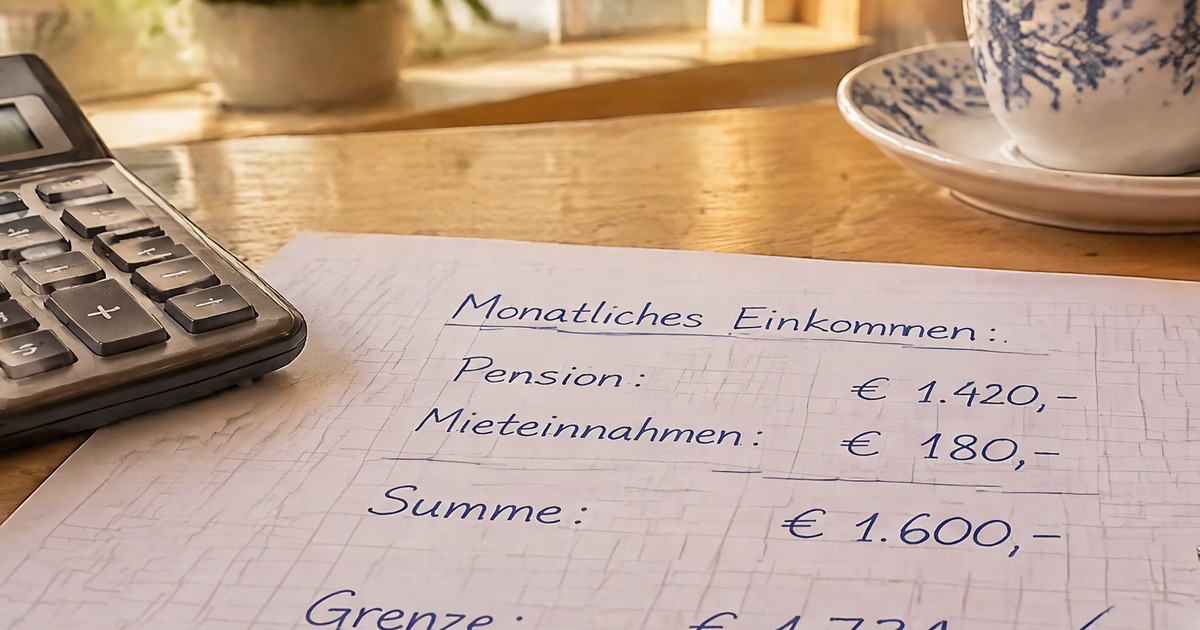
| 1 person | €1,465.40 |
| 2 people | €2,311.81 |
| Each additional person | + €226.11 |
These limits are pegged to the Ausgleichszulage rates and already include the statutory buffer. OBS determines income itself through the Transparenzdatenbank (government income database), which collects data from payslips and tax assessments.
Not everything counts as income. Familienbeihilfe (family allowance), Pflegegeld (care allowance), Grundversorgung (basic welfare for asylum seekers), accident pensions and war victims’ pensions are excluded. Some of these payments even serve as a qualifying entitlement while not counting as income - a rare double bonus.
If your income is slightly above the limit, the law allows deductible expenses. A flat €500 housing allowance is counted automatically: for tenants with net rent up to €500 and for owners alike. If your rent is higher, you can claim the actual amount with documents. Major medical and care costs as well as certain insurance premiums are also deductible - proven with your tax assessment. Keep this in mind if your household sits right at the edge: deductions often make the difference.
Befreiungsrechner: check your eligibility in five minutes
Before collecting documents, check your entitlement in the Befreiungsrechner (exemption calculator) on the OBS website. In a few steps it asks about your situation and shows whether you qualify and for which benefit.
The calculator works as a three-condition filter: age 18 or older, Hauptwohnsitz in Austria, and membership in one of the nine entitlement groups with income below the limit. The output is a personalised result: your pre-filled application, a document checklist and the eligibility assessment - all downloadable. It is the fastest way to see your prospects without collecting papers blind.
Practical tip: even if the calculator rejects one benefit, it checks the others in parallel. A single application covers the ORF fee, the telephone subsidy, the renewable-energy levy exemption and the social electricity tariff. The system matches every benefit you are entitled to.
How to apply: step-by-step instructions
Filing for the ORF fee exemption takes one evening. The procedure is described on the OBS application page and has four steps:
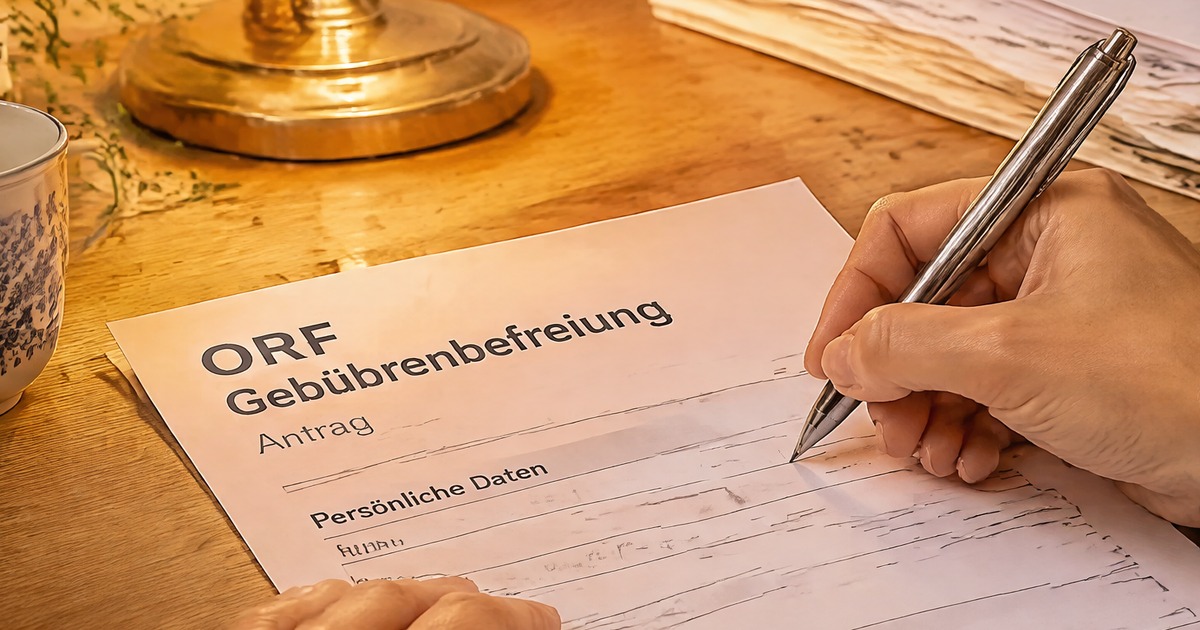
- Fill in the Kombi-Antrag (combined application). This single fillable PDF covers the ORF fee exemption, the social electricity tariff, the telephone subsidy and the EAG levy exemption. One application is checked against all benefits at once.
- Sign the form. Unsigned applications are not processed - this is the most common cause of delays.
- Attach documents as copies. Income proofs for every household member, proof of your qualifying entitlement, and documents for deductible expenses.
- Send the package to OBS. Three channels: online via the contact form on the OBS website (jpeg, png, pdf, up to 7 MB), by email to [email protected], or by post to ORF-Beitrags Service GmbH, Postfach 1000, 1051 Wien, Austria.
For the electricity benefits you need your Zählpunktnummer (metering point number) - 33 digits starting with “AT”. You will find it on your electricity bill or grid access contract, not on the meter itself. Once OBS grants the benefit, it forwards everything to your electricity provider automatically - no action needed on your side.
Documents: the complete checklist before you send
An incomplete package is the main reason decisions get delayed. Collect copies in advance and cross-check with the OBS checklist:
- Income proofs for all household members. Payslips, pension decisions, AMS decisions, grant confirmations. For students without income: proof of co-insurance plus a school or university enrolment confirmation.
- Proof of your qualifying entitlement. The exact document depends on your group from the table above: pension decision, AMS confirmation, Mindestsicherung decision, disability ID and so on.
- Documents for deductible expenses, if you claim medical costs or rent above €500.
- Zählpunktnummer from your electricity bill - only if you apply for the electricity benefits.
Pensioners only need the pension decision or a bank statement showing the payments. Students need proof that Studienbeihilfe is being paid. Unemployed applicants need a current AMS benefit confirmation. Recipients of minimum income support need their current Mindestsicherung decision. Check expiry dates: an AMS confirmation must be current at the time of filing.
Since 2026, OBS also delivers official decisions through Mein Postkorb (the government e-delivery inbox), accessible with ID Austria. Without e-delivery set up, decisions arrive by regular post.
With an exemption from the ORF-Beitrag you now also save on electricity: the energy price in the social tariff is capped at 6 cents per kilowatt-hour, plus €52.50 per year for the fourth and every additional household member.
- Official notice by the ORF-Beitrags Service GmbH (OBS)
What the exemption gives you: four benefits with one application
The ORF fee exemption is the gateway to a whole support package. The combined application opens four benefits at once, and each one matters:
- Exemption from the ORF-Beitrag and the Landesabgabe. The core benefit: you stop paying the fee and the state levy entirely, wherever it applies.
- Sozialtarif für Strom (social electricity tariff) from April 1, 2026. Under § 36 of the ElWG law, the electricity price for benefit recipients is capped at 6 cents per kWh for annual consumption up to 2,900 kWh. Larger families receive an extra €52.50 per year credit for the fourth and every additional person. Students on grants are the only group excluded.
- EAG-Kosten-Befreiung (renewable-energy levy exemption). The Erneuerbaren-Förderpauschale and Erneuerbaren-Förderbeitrag disappear from your electricity bill - both sit in the grid cost section.
- Zuschuss zum Fernsprechentgelt (telephone subsidy) of about €10 per month. The credit is applied to a landline or mobile contract with a partner operator - the list includes A1, Magenta, Drei, HoT and others. One subsidy per household.
Separately, you can request a Feststellung der Unterstützungswürdigkeit under the EnDG law - an official decision recognising your household as energy-poor. This document unlocks municipal heating subsidies and energy-efficiency programmes. For pensioners receiving Ausgleichszulage the package is especially valuable: it saves hundreds of euros a year.
Decision timeline and how long the exemption lasts
The exemption takes effect from the month following your application. The review itself takes a few weeks: with a complete package you receive a Bescheid (official decision) granting the benefit. If documents are missing, OBS sends a notice listing what is needed - you can submit them online, by email or by post, and the review continues.
The standard validity is up to 5 years (for the EAG tariff reduction, up to 3 years). A few weeks before expiry, OBS sends an Ablaufverständigung (expiry notice). File your new application right after receiving it - then the benefit continues without a gap and no new payment demand arrives.
One practical point: while your application is under review, keep paying any outstanding invoices. If the decision comes through retroactively, the overpayment returns as a Guthaben (credit balance) - OBS offsets it against future periods. Ignoring payment demands while waiting only risks late fees, and refunds can always be claimed afterwards.
Moving house and other changes: how not to lose the benefit
The ORF fee exemption is tied to your Hauptwohnsitz address, and that creates pitfalls. According to the OBS rules on changes, the exemption ends when you move to another address - even within the same city. At the new place you must file a fresh application.
Report other changes to OBS immediately: a name change, a change in household composition, or losing your qualifying entitlement (for example, your AMS benefit ending). If your income changes, you file a new application with current proofs. Short-term income fluctuations do not need reporting - your status at the time of the check is what counts.
The critical part: if you conceal a change, the exemption is revoked retroactively from the date the conditions stopped being met. OBS will issue a Rückforderung (claw-back demand) for every month of wrongful relief. Such debts are worse than a normal invoice because penalties may be added on top. Prompt, honest notification is always cheaper than concealment.
If your application is rejected: what to do next
A rejection is not the end of the road, and it usually has two causes. The first is an incomplete document package: OBS sends a preliminary notice listing the missing items, and you get the chance to supply them. This is the easiest scenario - the review simply resumes once the package is complete.
The second cause is failing the conditions: income above the limit or no entitlement from the nine groups. Here OBS notifies you in advance of the impending rejection (“Ergebnis der Beweisaufnahme”) - and you can still submit documents that prove your entitlement. Adding deductible-expense documents that bring your assessed income below the limit is a classic fix.
Even after a full rejection of the ORF fee exemption, one fallback remains: the EAG-Kosten-Deckelung (renewable-energy cost cap). Under § 72a of the EAG law, the renewable levies are capped at €75 per year - and no qualifying entitlement is required, only income below the limit. A neat detail: if your application was rejected solely for lack of an entitlement, you can apply for the EAG cap right away.
Frequently asked questions
How much can you earn to get the ORF fee exemption in Austria?
From January 1, 2026 the limit is €1,465.40 net per month for a one-person household, €2,311.81 for two people, plus €226.11 for each additional member. The net income of everyone in the home counts, while Familienbeihilfe, Pflegegeld and several other payments are excluded. If you are slightly above the limit, deductions help: a €500 housing allowance is counted automatically.
Do pensioners qualify for the exemption?
Yes, pensioners are one of the nine entitlement groups. A pension decision or a bank statement showing pension payments is enough. There is no separate pensioner income limit - the general household threshold applies. Pensioners receiving Ausgleichszulage almost always pass the income test without problems.
Do you pay the ORF-Beitrag for a second home?
No. The fee is tied only to your Hauptwohnsitz (main residence). A Nebenwohnsitz - a holiday home or a rented flat in another city for study or work - carries no ORF-Beitrag. An exemption granted for your main home does not transfer to a second one, but it is not needed there anyway.
What happens to the exemption when you move?
The exemption ends when your Hauptwohnsitz address changes - even within the same city. You must report the move to OBS and file a new application for the new address. If you keep using the benefit at the old address without reporting, OBS revokes it retroactively and demands repayment.
Wrapping up: your ORF fee exemption checklist
The ORF fee exemption saves a household up to €240 a year, and together with the social electricity tariff and the telephone subsidy the savings grow substantially. The procedure is free, entirely paper-based, and one evening is enough to assemble the documents.
Your action plan:
- Run the Befreiungsrechner on the OBS website and check your entitlement.
- Compare your income with the 2026 limit: €1,465.40 for one person, €2,311.81 for two.
- Collect copies: household income proofs, your entitlement document, and the Zählpunkt number for the electricity benefits.
- Fill in and sign the Kombi-Antrag to claim all four benefits at once.
- Send the package online, by email or by post - and wait for the decision that takes effect the following month.
- Report any move or income change to OBS immediately to avoid a claw-back.
If you are still planning your budget after a move, start with our overview of renting in Vienna - it breaks down all recurring household costs. And to keep up with new guides on life in Austria, subscribe to our newsletter - once a week we send the essentials for English-speaking residents.
Stay Up to Date with the Latest Austrian News
The week's top stories - news, guides, and insights about life in Austria. Every Sunday in your inbox.