
Eyelid Surgery and Insurance in Austria: When the Kasse Pays
Eyelid Surgery and Insurance in Austria: When the Kasse Pays When Austrian health insurance covers eyelid surgery: medical necessity vs cosmetics, visual field tests, ÖGK applications, Wahlarzt refunds and real costs. Topics: Daily Life, Healthcare.
Drooping upper eyelids are not just about looks. In Austria, eyelid surgery (Schlupflider-OP) can cost you €800–2,500 — or nothing at all. Everything hinges on one line: cosmetics versus medical necessity. Your Krankenkasse (public health insurer) covers the procedure only if the excess skin measurably interferes with your vision. This guide explains how the visual field test works, how to apply to ÖGK, SVS or BVAEB, how a private doctor differs from a contracted one, and what to do after a rejection. Plus real prices and timelines, so you do not pay for something your insurance should cover. The rule works the same in Vienna as in Linz or Graz. We walk you through every step, from the perimetry test to the final bill.
What are Schlupflider and what does the Blepharoplastik do
Schlupflider (drooping eyelids) are excess skin on the upper eyelid that folds down over the eye. As skin loses elasticity with age, the fold becomes more pronounced. Sometimes it hangs far enough to cover part of the pupil.
In a Blepharoplastik (blepharoplasty), the surgeon removes the excess skin and, where needed, parts of muscle and fatty tissue. Upper lid surgery takes 30 to 45 minutes and is usually done on an outpatient basis under local anaesthesia.
Typical complaints: heavy lids, a tired look, and the need to raise your eyebrows while reading or driving. Constant tension in the forehead muscles causes headaches by the end of the day. These functional symptoms are the first sign that this is not only about aesthetics.
Droopy lids usually appear after the age of 40 to 45, when the eyelid skin loses collagen. Sometimes the fold is congenital or shows up early due to genetics. Contact lens wearers notice it first: the hanging lid catches the lens with every blink.
There are everyday signs too: eyeshadow smudges, eyeliner prints onto the upper fold, and make-up simply stops holding. Many patients see a doctor with exactly this complaint, long before vision is affected.
Medical necessity or cosmetic: the line that decides everything
The entire „who pays“ question comes down to two terms. Medizinisch notwendig (medically necessary) means the surgery restores a function, such as your field of vision. Kosmetisch (cosmetic) means it only improves appearance without any health benefit.
According to oesterreich.gv.at, Austrian insurers distinguish between mandatory and voluntary services: treatment of illness or functional impairment falls under basic coverage. Pure aesthetics do not. As Salzburg24 points out, simply being unhappy with your reflection gives the insurer no reason to pay.
In practice: do not spend money on private consultations before an ophthalmologist has confirmed a functional impairment. First the proof, then the application, then the surgery. That order saves both months and thousands of euros.
| The Kasse may pay | The Kasse does not pay |
|---|---|
| Proven narrowing of the visual field by excess skin | A tired look without functional impairment |
| Headaches from constant forehead and brow strain | The wish to simply look younger |
| Ptosis (drooping lid from a weak levator muscle) | Eye bags and lower lid surgery |
| Side vision problems that affect driving | Purely cosmetic reshaping of the lid crease |
A possible indication exists when excess upper lid skin hangs down so far that it measurably restricts the upper or lateral field of vision.
— Dr. Stefan Gärner, plastic surgeon, Vienna
The same principle reaches far beyond the eyelids. In a breast reduction, insurers take documented back and neck pain into account. After major weight loss, skin infections in the abdominal folds are the argument for a tummy tuck. Nose septum surgery is covered when it restores breathing, not the shape of the nose.
The principle is always the same: complaints must be measurable, documented by doctors and directly linked to the planned procedure. Ask your surgeon for an opinion written specifically for your fund’s criteria, not a generic description of the operation. And as with the lids, the application comes before the operation, not after.
When the Kasse pays: the proven visual field restriction
The central concept of the whole process is the Gesichtsfeldeinschränkung (visual field restriction). Droopy lids alone prove nothing: the fold can be clearly visible without touching your sight. The insurer only pays for a narrowing that is measurably confirmed.
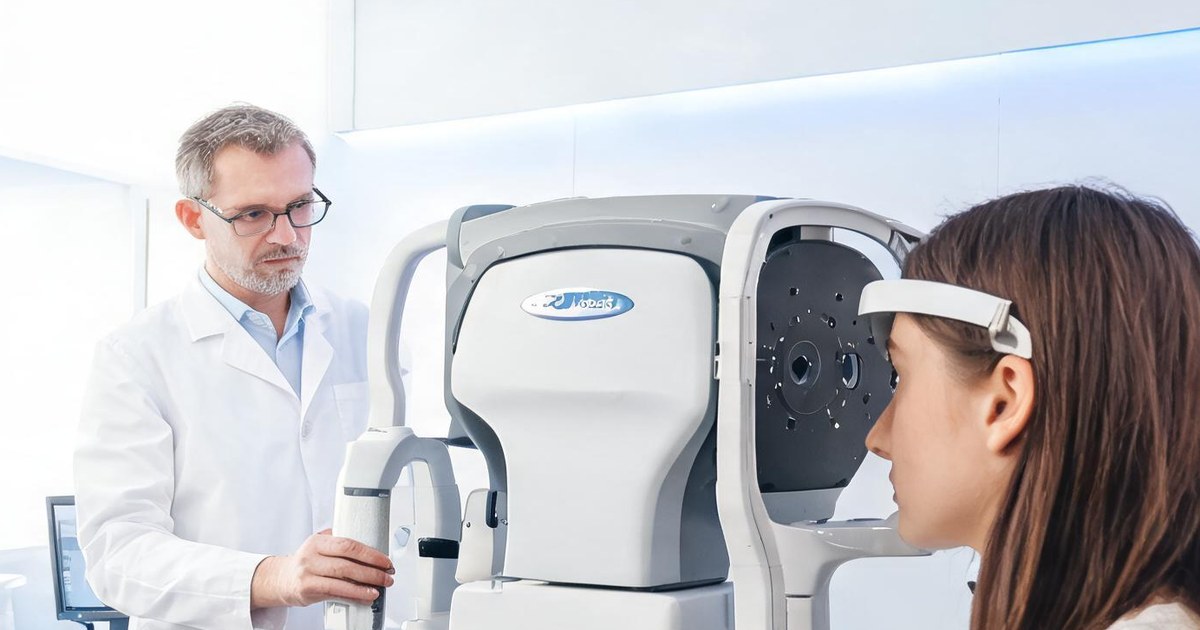
The proof comes from a Gesichtsfeldmessung (visual field test, perimetry) at the ophthalmologist. The doctor measures which area you can see while looking straight ahead — first with the lids hanging naturally, then with the excess skin lifted manually. If lifting the skin clearly widens the upper visual field, the finding is documented, as the Viennese surgeon Dr. Gärner explains.
Modern perimetry runs on a computer: you fixate a central point and press a button whenever you notice light flashes at the edge of your field of vision. The software builds a visibility map for each eye separately. Comparing the two maps — with hanging and with lifted skin — is the main evidence for the fund. Keep a copy of the protocol: it helps both with a second application and with contesting a rejection.
Important to know: even clearly visible droopy lids do not create an automatic entitlement. As the ophthalmology practice in Villach notes, how generously your insurer contributes depends on the fund. Some share the costs without much questioning, others refuse even with a clear medical logic.
That is why the documents matter more than the operation itself. A package that is complete on the first attempt saves months of correspondence with the fund.
The examination at the ophthalmologist: what gets checked
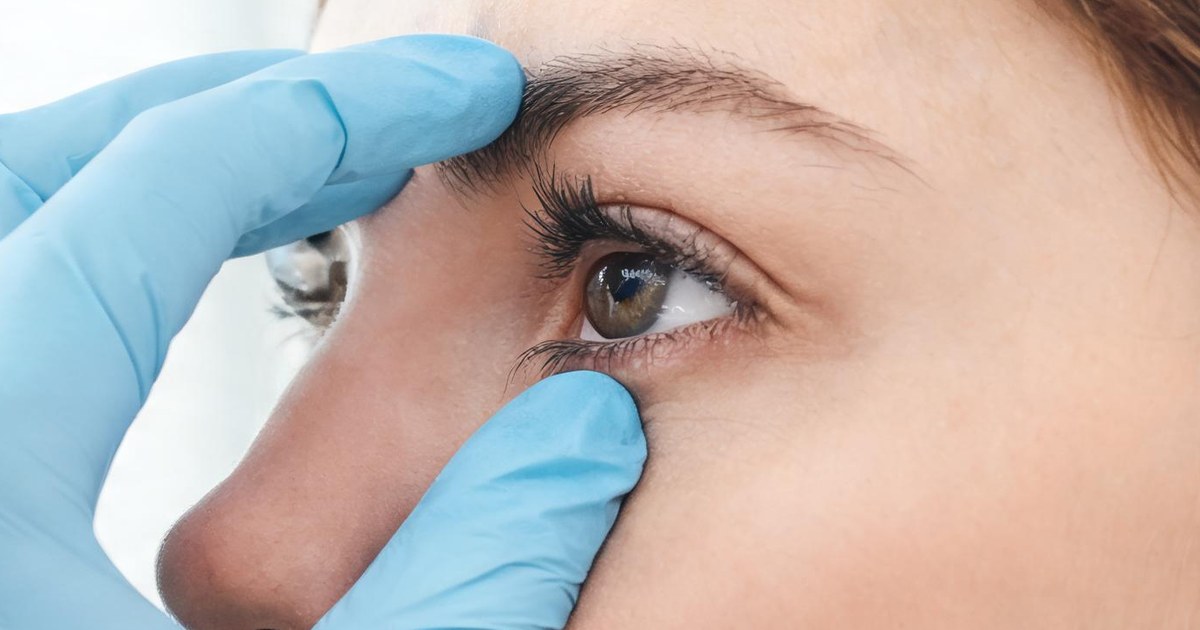
The first step for any applicant is a visit to the Augenarzt (ophthalmologist). The doctor checks not only perimetry but also other causes behind the complaints. One example is Ptosis, where the lid droops because the levator muscle is weak. That condition requires a different operation and is assessed separately.
The ophthalmologist’s job is exclusion: they confirm that the narrowed visual field really comes from excess skin, not from an eye disease. This matters because removing skin does not help if the eye itself is the problem.
The second half of the application package comes from the operating surgeon: they assess the excess skin, document the lids with photographs and write a fachärztliche Stellungnahme (specialist medical opinion). It justifies the necessity and the planned scope of the surgery. Together, both findings form the basis on which your insurer decides.
One piece of good news about costs: perimetry itself is a regular insurance service at a contract ophthalmologist and costs you nothing. Expenses begin when the operation with a private surgeon comes into view.
Applying to the Kasse: documents and procedure
You submit the application for Kostenübernahme (cost coverage) to your insurer: ÖGK for employees, SVS for the self-employed, BVAEB for public-sector staff. The procedure is similar across funds, but requirements can differ in the details.
The standard package includes:
- The ophthalmologist’s report with perimetry proving the restriction;
- The surgeon’s specialist opinion with photo documentation;
- A Kostenvoranschlag (cost estimate) for the operation;
- The application form of your fund or a cover letter.
You can submit the documents in person at a branch office, by post, or through the fund’s digital services. Ask for a reference number when filing — it makes tracking the status much easier.
There is no fixed legal deadline for the decision: it depends on the fund and the completeness of your documents. A missing file means follow-up requests and weeks of delay. The practical advice from Viennese practice: apply early and only book a surgery date once the written decision is on your table.
For some services the fund adds a chefärztliche Bewilligung (chief physician approval) — an internal medical review by the insurer. Eyelid surgery belongs to the services that get examined particularly closely. Do not be surprised if additional documents are requested after you have applied.
Contracted doctor or private: Wahlarzt versus Kassenarzt
Austria has two kinds of outpatient doctors. The Kassenarzt (contract doctor) treats you at the insurer’s expense — you pay at most a small Selbstbehalt (co-payment). The Wahlarzt (choice doctor, private) sets their own fee and issues a Honorarnote (private invoice) that you pay yourself.
Most surgeons who perform blepharoplasty work as Wahlarzt — there are almost no contracted plastic surgery positions. In practice this means: you pay for the operation upfront and then request reimbursement from your fund.
The ÖGK rule: it refunds 80 percent of what it would have paid a contract doctor for the same service — not 80 percent of your invoice. Because private surgical fees sit far above the tariff levels, the actual refund is often only a fraction of the bill. You cover the difference yourself unless a private top-up insurance does.
A simple calculation: the private invoice for the operation is €2,000, the contract tariff for the same service €600. Around €480 gets refunded — that is 80 percent of the tariff. The remaining €1,520 stays with you, so request the cost breakdown in writing before the operation.

What eyelid surgery costs: real prices
The price depends on the scope of the procedure and the surgeon’s qualification. A simple correction of one upper lid at a surgeon specialised in eyelids can start around €800. A typical range for both upper lids is €1,500–2,500.
The upper end of the market sits noticeably higher. A surgical practice in Linz quotes starting prices of €2,500 for lid surgery, as listed on Dr. Hillisch’s page. In Vienna, plastic surgeons start at €3,000 — the same order of magnitude quoted by the practice of Dr. Gärner, whose perimetry approach we described above.
Lower lid work is almost always more expensive than upper lids, because more fatty tissue is involved, reports Salzburg24. Anaesthesia and follow-up visits belong in the estimate too — ask for the full Kostenvoranschlag before you sign anything.
Request an itemised breakdown: what the operation itself costs, what the anaesthesia, what the follow-up appointments. A one-line estimate is a reliable sign that „additional items“ will appear later.
If the fund approves coverage for medical reasons, it covers only the functional part: the skin that blocks your vision. Cosmetic add-ons — for example a simultaneous lower lid correction — remain a private expense on your bill.
If you want to avoid paying extra altogether, there is a fallback: the public hospital. Once the fund has recognised the necessity, the operation can be done there or in a contracted facility under fund rules — you pay only the standard hospital contribution. The practice of Dr. Gärner explicitly names this route as the alternative for patients who do not want to top up privately.
The downside: waiting lists and a surgeon assigned by allocation rather than choice. Sometimes the operation is done under general anaesthesia when the scope is larger than usual. For a functional lid correction this is usually an acceptable compromise — what counts is the open gaze, not the brand of the clinic.
The smart strategy: file the application and in parallel ask the fund about outpatient options at the nearest hospital. If the waiting list is short, you save thousands of euros without losing quality.
Zusatzversicherung: when private top-up insurance helps
A Zusatzversicherung (private top-up insurance) is your second chance after the public fund says no. Comfort-tier policies refund part of private doctor fees and outpatient surgery, and some tariffs even cover aesthetic procedures.
The catch: conditions differ radically between policies. Some plans pay the remainder after the fund’s reimbursement or even the entire amount — others explicitly exclude aesthetic surgery in their terms.
The only safe route is a written inquiry with your insurer before the operation. This is exactly what Viennese surgeons recommend: verbal promises from a hotline are worth nothing, while a written answer fixes what will be refunded and at what level.
Look for three phrases in the policy conditions: ambulant operierte Leistungen (outpatient surgery), Wahlarztambulanz (private doctor treatment) and ambulante Zuschüsse (outpatient allowances). If none of these terms appears in your tariff, do not expect anything for an operation with a private surgeon.
Rejected by the Kasse: your next steps
A rejection is rarely the end of the story — usually it signals that the documents were not convincing enough. First, ask the fund in writing why the application was refused. If evidence was missing, a repeat perimetry or an additional specialist opinion can help.
If the refusal came as a formal Bescheid (official decision), you can contest it. Social insurance disputes are heard by the Arbeits- und Sozialgericht (labour and social court) — a point the practice of Dr. Gärner also stresses. Mind the filing deadlines stated in the decision — they are short.
Most rejections use a standardised wording: the medical necessity has not been proven sufficiently. In that case, a repeat perimetry with a complete protocol focused on the upper zone often changes the picture on a second application.
In parallel, there is always the pragmatic route: financing the operation yourself. Many patients choose this path after a rejection — the medical work-up is still worthwhile, so that what gets operated is what is truly necessary, not merely what looks nice.
Recovery and sick leave after the operation
The surgery itself is short: 30 to 45 minutes, outpatient, under local anaesthesia. You go home the same day with a dressing and a plan for follow-up visits. Swelling and bruising are normal during the first week.
Realistically expect 7 to 14 days of sick leave: that is how long stitches and a presentable face usually take. For employees this means getting a sick note from your doctor. We explain how paid sick leave works and how long you can stay home in our guide to sickness benefits in Austria.
During the first days, sleep with your upper body raised and cool the area with compresses — this noticeably reduces swelling. Reading and screens are usually allowed after a few days, sport after two to three weeks. Decorative cosmetics on the scar area come only after full healing.
You return to office work after one to two weeks, as long as nothing heavy needs lifting. Get behind the wheel once your field of view is fully clear again and the lids have stopped swelling.
The final result is assessed after 4 to 6 months, once scars fade and tissue has healed. The surgical technique is identical regardless of who pays — only the amount of skin removed differs.
Frequently Asked Questions
Does the Kasse pay for lower lids and eye bags? Usually not. Lower lid surgery (Unterlidstraffung) is almost always considered cosmetic, because eye bags are not a functional impairment. Exceptions exist only in rare individual cases with a proven functional problem.
How long does the application take to process? There is no fixed deadline — it depends on the fund and the completeness of your documents. Incomplete applications mean extra requests and weeks of delay, so apply early and only book the operation after the written decision arrives.
Do I get all my money back after surgery with a private doctor? No. The ÖGK refunds 80 percent of the contract-doctor tariff, not of the private invoice. With a much higher surgical fee, the actual refund stays small — you or your top-up insurance cover the rest.
Is surgery abroad cheaper? Experts advise against medical tourism, as Salzburg24 reports: travel and accommodation eat the savings, and complications must be corrected at home, on your own budget.
Do I have to start with a plastic surgeon? No. Start at the ophthalmologist: first the visual field restriction has to be proven. The surgeon joins afterwards, once the medical context and the scope of the procedure are clear.
What if my vision is not affected but I really want the operation for myself? Then it is an honest cosmetic procedure: budget €800 to €2,500 and do not waste time on applications — the fund does not pay for interventions without a vision impairment.
Conclusion: your action plan
Eyelid surgery becomes an insurance case in Austria for exactly one reason: a proven restriction of the visual field. Everything else is aesthetics at your own expense. The good news: with a complete application package, the path from the ophthalmologist to the fund’s decision usually takes only a couple of months. Your checklist:
- Book an ophthalmologist appointment — ask for perimetry with lids hanging and lifted;
- Get the surgeon’s opinion with photo documentation and a cost estimate;
- Apply to your fund (ÖGK, SVS or BVAEB) and clarify the required documents first;
- Check your Zusatzversicherung in writing before booking anything;
- Only schedule the operation after the written approval;
- If rejected: complete the documents or contest the decision at the social court.
Which insurers exist in Austria and how they differ is covered in our overview of Austrian health insurers. What the Kasse covers at another „cosmetic“ specialist — the dentist — is explained in our guide to what the Krankenkasse pays at the dentist. If you are self-employed, our article on health insurance without a job in Austria covers the basics — a gap in coverage gets expensive with any planned procedure.
If you wonder what the small fee at your ÖGK doctor visits means, read our explainer on the ÖGK co-payment. And subscribe to our newsletter so you miss no new breakdowns of Austrian medicine and insurance.
Stay Up to Date with the Latest Austrian News
The week's top stories — news, guides, and insights about life in Austria. Every Sunday in your inbox.