
Re-register your car after moving to Austria: deadlines, costs, documents
Re-register your car after moving to Austria: deadlines, costs, documents Re-register your car after moving to Austria: deadlines, documents and costs. Plates, insurance, the NoVA tax and the §57a inspection sticker explained. Topics: Daily Life, Transport.
Your car made it to Austria with you — now comes the paperwork. Whether you must act depends on where you moved from and where you moved to: Zulassung (vehicle registration) rules differ for every scenario. Sometimes a one-week notification is enough, in other cases you need a full re-registration with new plates and payment of the NoVA tax (Normverbrauchsabgabe — the one-off motor tax). This guide walks through the deadlines, the exact document list, official fees, the difference between EU and third-country imports, and the Pickerl inspection rules. Everything is based on the official oesterreich.gv.at pages and checked for 2026.
When a car must be re-registered after a move
The core rule is § 42 of the Austrian KFG (Kraftfahrgesetz — the Motor Vehicles Act): the duty to re-register is triggered not by the move itself but by a change of the responsible registration authority. The authority code printed on your number plate tells you what applies.
According to the official instructions, there are three scenarios. First: you move within the jurisdiction of the same authority — for example from Vienna’s 3rd to the 10th district. The plate code «W» stays the same, so nothing is required: the registration database is updated automatically and your certificate remains valid.
Second scenario: the plate code changes but the authority stays the same. The official example is a move from Wiener Neustadt («WN») to St. Pölten («P») — both are served by the same authority, the Landespolizeidirektion Niederösterreich. Here you only need to report the change.
Third, the expensive case: your new address falls under a different authority — say, moving from Baden (Lower Austria) to Vienna. Then you must deregister (Abmeldung) and re-register with new plates, paying the same fees as a first-time registration.
There is no obligation to report a change of main residence if the change occurs within the jurisdiction of the same authority and in a municipality with the same authority designation on the number plate.
— oesterreich.gv.at, the Austrian government portal
Deadlines: how much time the law gives you
The official deadlines are stricter than most expats expect. If your new address belongs to another authority, deregistration and re-registration must happen simultaneously with the move to your new main residence — not “within a month”, but right away.
If the authority stays the same but the plate code changes, you have exactly one week from the address change to notify the authority. Missing the deadline can result in a Verwaltungsstrafe (administrative fine), as the official instructions warn explicitly.
In practice the clock also ties into residence registration: the Meldezettel (residence registration form) must be filed within three days of moving in. Registering your residence is a precondition for car paperwork, because the registration service checks your main residence against the central population register. If you are still planning the move, start with housing — our guide to renting an apartment in Austria explains the whole process.
There is one pleasant exception inside this strictness: in the first scenario — same authority code — no application, no visit and no payment are required at all. The address change inside one authority’s area is recorded automatically: the residence registration office passes the new data into the vehicle register, and the certificate showing the old address stays valid. That saves a trip, a day off work and the plate fee.
Documents for re-registering a car
The document list depends on whether you need a full registration or just a notification. For the full procedure (new authority, new plates), bring to the Zulassungsstelle — the registration desk usually run by an insurance company:
- a photo ID of the applicant;
- Versicherungsbestätigung — confirmation of a valid Austrian motor insurance policy;
- the Genehmigungsnachweis (approval document): Typenschein (type approval certificate), Einzelgenehmigung, the COC (Certificate of Conformity) or a printout from the Austrian approval database;
- for a re-registration, the Fahrzeug-Genehmigungsdokument — Part II of the registration certificate glued together with the approval document;
- if the car was previously registered in another EU country — both parts of the registration certificate (Zulassungsbescheinigung Teil I and Teil II);
- for imports — the NoVA payment confirmation from the Finanzamt, and for third-country imports possibly the customs clearance document;
- for used cars — a valid positive inspection report if the Pickerl deadline has already passed;
- a written Vollmacht (power of attorney) if someone registers the car on your behalf.
The desk procedure itself is quick: there is no form to fill in — the clerk enters the data and you only sign the application. After the fees are paid you receive the number plates and the inspection sticker on the spot, and the registration service assembles the Fahrzeug-Genehmigungsdokument from Part II of the certificate and the approval document — exactly the set you will present at the next registration. If you choose the credit-card certificate instead of paper, a temporary paper Teil I is issued immediately, while the card arrives by post within two weeks and is valid for at most eight weeks. A Voranmeldeverfahren — pre-submitting your data — can speed up the desk visit further.
One relief: you do not need to bring separate proof of residence — the registration desk queries the Zentrales Melderegister (central register of residents) itself and adds €1.10 to your bill. And for newcomers from outside the EU: insurance and taxes work the same for EU citizens and non-EU citizens — what matters is your legal status, which we break down in our guide to Austrian residence permits.

Insurance first, plates second
In Austria no car can be registered without a valid Kfz-Haftpflichtversicherung — mandatory motor liability insurance. The official rules require the policy to be signed before you apply for registration, and it must be issued by a company licensed to provide liability coverage in Austria.
A practical detail most summaries skip: the registration desk belongs to an insurance company. If your insurer has no desk in your new district, the desk of another insurer will process your registration. So compare not only prices but also the desk network of each insurer.
Premiums depend on the federal state, annual mileage, car type and your claims history. Drivers arriving from outside the EU should immediately ask their insurer to credit their no-claims record from abroad — it can noticeably reduce the premium. If you are also sorting out health coverage, our overview of health insurance in Austria untangles that parallel system.
What re-registration costs
The official fees are uniform across Austria because they are set centrally. According to oesterreich.gv.at, a full passenger-car registration in 2026 costs:
| Item | Amount |
|---|---|
| Behördenanteil (government fee share) | €178 |
| Bearbeitungsleistung (registration desk service) | €65.60 |
| Central residents register query | €1.10 |
| Begutachtungsplakette (inspection sticker) | €2.30 |
| Number plates (passenger car) | €23 |
| Number plates (motorcycle) | €13 |
| Scheckkartenzulassungsschein (credit-card certificate, optional) | €31.10 |
In total, a passenger car with new plates costs about €270 — plus insurance. If only the plate code changes within the same authority, you pay just for the new plates and the inspection sticker — a fraction of a full registration.
A detail people forget: if you use a Digitalen Vignette (the digital motorway toll sticker) and your plate changes, you must notify ASFINAG and pay €18 for re-registering the vignette — the official instructions state this explicitly.
Importing a car from an EU country: NoVA and COC
Moving from Germany, Italy or another EU country means no customs duties — the EU is a single customs area. But the NoVA still applies: under the USP.gv.at rules, private importers (Eigenimport) calculate the tax themselves and pay it to the Finanzamt using form NoVA 2 — and the car can only be registered after payment.
Since 1 March 2022 the NoVA is calculated from CO₂ emissions under the WLTP cycle. The formula: subtract the deduction from the CO₂ value and divide by five — that gives the rate in percent of the taxable base. The deduction shrinks every year: it was 112 g/km in 2022 and has dropped by 3 g per year since 2025 — 96 g/km in 2026. The maximum rate has climbed to 80%.
Example: a car with 155 g CO₂/km. Rate: (155 − 96) / 5 ≈ 12%. For a used car the base is the gemeiner Wert (market value, usually from the Eurotax catalogue). At a base of €20,000 the tax is 12% × €20,000 − €350 (a fixed deduction) = €2,050. High-emission diesels and petrol cars above the threshold also pay a Malus: since 2025 that is €80 per gram of CO₂ above 155 g/km. Electric and hydrogen cars pay 0% NoVA — one more reason moving to Austria with an EV is financially smart.
A separate case is leasing. Leased cars with their permanent location in Austria are also subject to NoVA, even if the lessor is based abroad: what counts is where the car is physically used, not where the owning company is registered. And from 1 July 2026, in cross-border leasing within the EU/EEA the tax can already be reduced at registration by a flat amount for the period of temporary use abroad — a noticeable relief for anyone bringing a leased car.
Among the documents, the COC — the EU Certificate of Conformity issued by the manufacturer — is critical: registration is impossible without it or an equivalent approval document. The official tip: if you buy from a private seller, have the signature on the purchase contract notarised in the country of purchase.

Importing from a third country: duty and Übersiedlungsgut
Bringing a car from Russia, Ukraine, Serbia or any country outside the EU follows a different tariff. Under the official rules, at the Austrian border you pay 10% customs duty on the car’s value (purchase price plus transport to the EU border) and 20% import VAT — on the sum including the duty.
Two legal routes can reduce that bill. First, a preferential certificate (EUR.1, or an origin declaration on the invoice for values up to €6,000): with some countries the EU has free-trade agreements, and then no duty applies at all — Switzerland and Norway are examples. Second, the Übersiedlungsgut status (household goods moved on relocation): if the car is part of your move to Austria, the official rules grant exemption from both the duty and the import VAT. The conditions are strict — you must have owned and used the car abroad for a minimum period before the move — so clarify the details with the Finanzamt well in advance.
Then the chain continues: Typisierung (technical type inspection in Austria, if there is no EU approval), payment of the NoVA, and a normal registration. At the border you will need the purchase contract with proof of payment, the electronic Versandanmeldung (export declaration) and the Einfuhranmeldung (import customs declaration), plus preferential certificates if you have them. If no money changed hands — a gift, for instance — or the customs officers doubt the price, an assessment by a sworn expert is required; budget time and money for that. Count on several weeks for a third-country car — especially if you are also swapping your driving licence at the same time.
The Pickerl inspection: the 3-2-1 rule
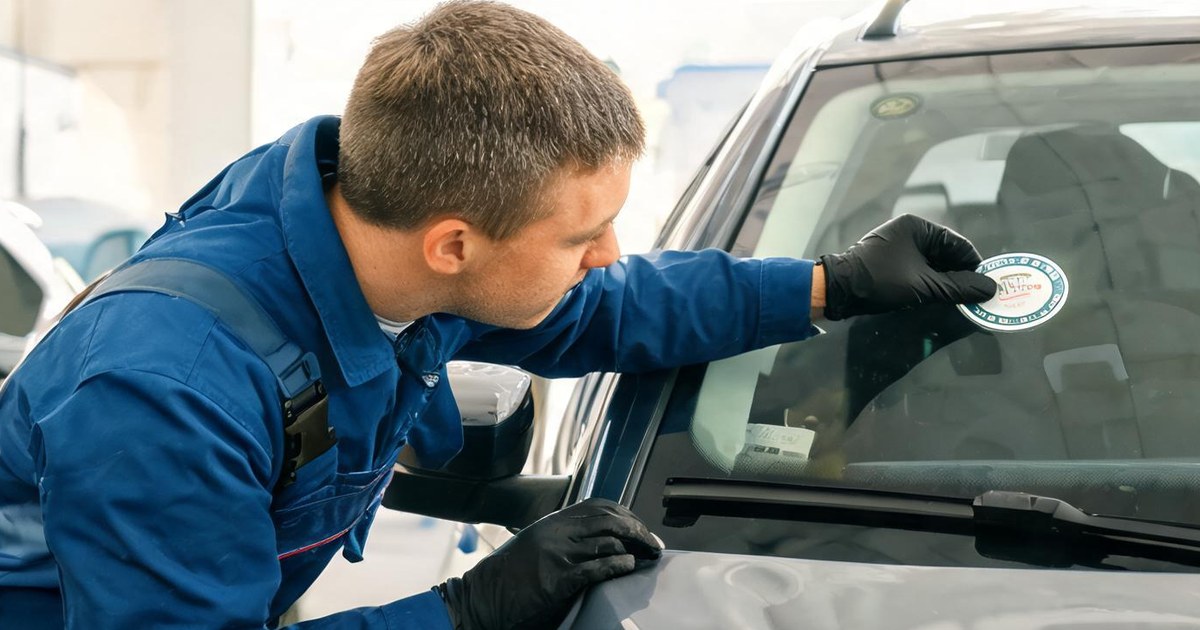
The Austrian technical inspection is the §57a-Begutachtung, and its sticker is the Pickerl. For passenger cars the so-called 3-2-1 rule applies: the first inspection comes 3 years after the first registration, the second 2 years after the first inspection, and every further one every 12 months. Motorcycles and mopeds have followed the same intervals since 1 March 2020.
There is flexibility: the inspection can be done anywhere from one month before to four months after the month stamped on the sticker, without shifting the next deadline. Taxis, emergency vehicles and trucks are inspected annually, historic vehicles every two years. All intervals are listed on the Begutachtung page of oesterreich.gv.at.
For movers, one practical consequence matters: when registering a used car whose Pickerl deadline has passed, a valid positive inspection report is required before registration. At private workshops and club stations (ÖAMTC, ARBÖ) the inspection starts around €70–€100 — cheaper to do it before you queue for plates than to be turned away.
The deadline is anchored to the month of the car’s very first registration, so every imported car has its own date. If that date is inconvenient — falling in winter, say — it can be shifted: you file a request with the Zulassungsbehörde (the district authority, the Magistrat, or Vienna’s Verkehrsamt) asking for a different reference date. The sticker is replaced, and the next inspection counts from the new date.
The 3-2-1 rule applies to both new and already registered vehicles of class L: three years after the first registration, two years after the first inspection, then annually.
— oesterreich.gv.at, Begutachtung section
Kennzeichen plates: what happens to your old plates
Austrian Kennzeichen (number plates) are issued right at the registration desk after you pay the fees — you walk out with a pair of plates and the inspection sticker. The code on the left is the administrative authority code: W for Vienna, N for Lower Austria, O for Upper Austria, S for Salzburg, T for Tyrol and so on.
The full list of codes for all federal states is published on the official portal, and it is useful twice over: to check whether your code changes when you move, and to identify which authority your current plate belongs to. Vanity combinations (Wunschkennzeichen) are available for an extra fee.
Old plates survive a full re-registration as souvenirs — but you may not drive with them. Austrian plates, like German ones, are tied to both the car and the registration authority, so you cannot carry your plate from one state to the other.
Cars on foreign plates: when it becomes a violation
A common trap for newcomers: keeping the car on its home-country plates “for the first few months”. The law sees it differently. As soon as your permanent residence — and with it the dauernder Standort of the car (its permanent location) — is in Austria, the vehicle must receive Austrian registration and the NoVA becomes payable. The logic is simple: living in Austria for years on foreign plates while skipping registration is a violation, not a grey zone.
The same rule covers leased and company cars: where the car is physically used matters more than where the owner is registered. The practical takeaway: do not stretch the re-registration beyond the schedule set out in the first sections — fines for missing the deadline plus NoVA interest cost more than any “saving” from postponing. If you are only temporarily in Austria on German or Slovak plates and regularly drive abroad, count how many days a year the car actually spends in Austria: that share decides whether the location counts as permanent.
Frequently asked questions
Do I need to re-register my car when moving within Vienna? No. The authority code «W» does not change, and under § 42 KFG your registration certificate remains valid. The registration database is updated automatically via the residents register.
What happens if I miss the re-registration deadline? If the authority stays the same but the plate code changes, the law gives one week to notify. Violations can trigger an administrative fine. When moving to a new authority’s jurisdiction, registration must coincide with the move itself.
How much does it cost to re-register a car after moving to Austria? A full passenger-car registration: €178 (government fee) + €65.60 (desk service) + €1.10 + €2.30 + €23 for plates — about €270 plus insurance. If only the plate code changes, you pay just for the plates and the inspection sticker.
Is NoVA due when moving to Austria from Germany? Yes. EU imports are duty-free, but the NoVA (one-off registration tax) must be paid before registration, calculated from CO₂ via form NoVA 2 at the Finanzamt. Electric cars are the exception: their rate is 0%.
Wrap-up: your car re-registration plan
Re-registering a car after moving to Austria is not one procedure but a four-step kit, and almost every step can be done in a single day. The short checklist:
- Register your residence (Meldezettel) within the first three days.
- Check the authority code on your plate: unchanged — do nothing; changed — notify within a week; new authority — full re-registration.
- Sign an Austrian Kfz-Haftpflicht policy and get the Versicherungsbestätigung.
- For an EU import, pay the NoVA using form NoVA 2 (calculate from CO₂ first); for a third-country import, sort out the 10% duty, 20% import VAT or the Übersiedlungsgut exemption.
- Prepare the papers: COC or Typenschein, both certificate parts, and a valid Pickerl if due.
- Register at an insurance desk in your new district and pick up your new plates.
A car in Austria means Alpine weekends and easy commutes — and one desk visit plus well-prepared papers separate you from that freedom. If you are at the start of the journey, begin with our complete guide to moving to Austria, and to keep up with changes in registration and tax rules, subscribe to our newsletter — we track oesterreich.gv.at updates and explain them in plain language.
Stay Up to Date with the Latest Austrian News
The week's top stories — news, guides, and insights about life in Austria. Every Sunday in your inbox.