
Documents for Austrian Citizenship: The Complete List and Requirements
Documents for Austrian Citizenship: The Complete List and Requirements Documents for Austrian citizenship: full checklist, apostille and certified translations, validity periods, where to apply (MA 35, BH) and rejections. Topics: Migration, Citizenship, Residence Permits.
Collecting the documents for Austrian citizenship is the longest stage on the road to the passport. The decision itself takes months, but preparing the file often drags on for half a year. The reason is simple: MA 35, Vienna’s immigration and citizenship department, and the district offices called BH check every certificate, every translation and every apostille. In 2025, Austria granted 15,512 new citizenships — 19 percent more than a year earlier, according to Statistik Austria. Behind each of these decisions stands a stack of carefully gathered paperwork. This guide covers the full document list, apostille and translation rules, validity periods and the mistakes that send applications back.
The complete list of documents for Austrian citizenship
The documents for Austrian citizenship fall into two groups: certificates with no expiry date and certificates with a limited validity. The division is not ours — Vienna’s MA 35 uses it in its official list of required documents. The logic is simple: timeless papers can be collected early, while “fresh” ones must be ordered shortly before you apply, or they expire.
The basic set looks like this: your Geburtsurkunde (birth certificate), a Lebenslauf ab Geburt (a biography covering your life since birth), proof of German, your passport, a photo, health insurance, income records and criminal-record certificates. On top come family-status documents — marriage, divorce and death certificates, plus custody rulings. The full procedure is covered step by step in our application guide.
| Document group | What it includes | Validity |
|---|---|---|
| Civil status | Geburtsurkunde, marriage, divorce, death certificates | No expiry |
| Biography | Lebenslauf ab Geburt, school reports, diplomas | No expiry |
| Integration | German B1 certificate, “Mein Österreich” test | No expiry |
| Identity | Passport, biometric photo | Photo — up to 6 months |
| Finances | Payslips, tax assessments, KSV 1870 report | Report — 8 months |
| Criminal record | Certificates from every country of residence | Up to 12 months |
One rule applies to every paper: you show up with originals and copies. Electronic versions should be prepared in advance as PDF or JPEG. Structure the folder: timeless documents first, then the financial block, and fresh certificates last. The office processes dozens of cases a day, and a tidy file is always reviewed faster.
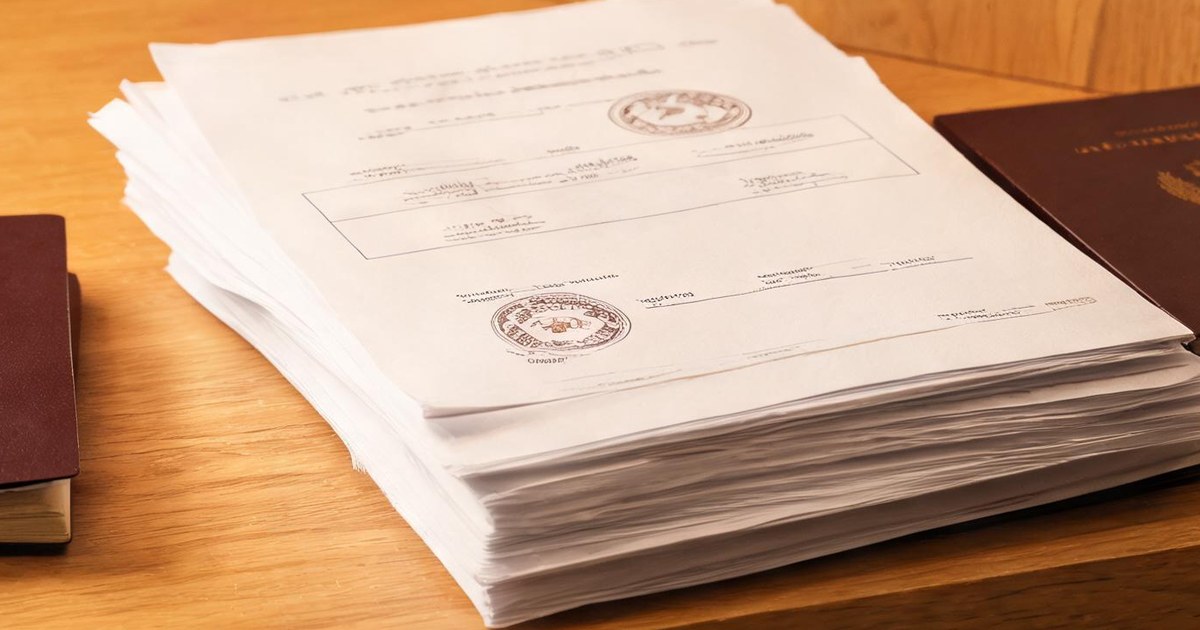
Documents without an expiry date — collect them early
The timeless certificates are the foundation of your file. They never expire, so MA 35 explicitly advises gathering them before the initial information session. This group includes the birth certificate, all marriage and partnership certificates, divorces with proof that the ruling became final, and death certificates of spouses.
If you changed your first or family name, add the name-change documents. For “name chains” — patronymics, the grandfather’s name and so on — the consulate of your country of origin issues a separate confirmation of the correct spelling. Applicants from post-Soviet countries run into these chains most often, and this is exactly where most files break.
A separate block is the Lebenslauf ab Geburt, a biography starting at birth. It must list every place of residence since birth, each with dates. The applicant signs it personally. If anything changes after you draft it — marriage, divorce, the birth of a child, a move — the biography must be updated. This is a formal MA 35 requirement, and an outdated Lebenslauf is a frequent reason for rejection.
The third block covers education and integration. All annual and final school reports from Austrian schools, decisions awarding academic degrees, and for degrees from third countries the Nostrifizierung decision — the recognition of your qualification in Austria. If you ever applied for asylum, add all asylum decisions and the transcript of your first interview. Anyone proving exceptional integration through volunteering needs written confirmations from organisations covering at least 3 years of activity.
Do not forget the children: minors need their own mini-file — a birth certificate, custody documents and written consent from both custodial parents. Details are in our guide to Austrian citizenship for children.
Certificates with a limited validity — order them last
Fresh certificates are the most delicate part of the package. You cannot order them early: each has a hard shelf life. The short list: your passport (it must stay valid throughout the procedure), a biometric photo no older than 6 months, a current insurance statement (Versicherungsdatenauszug) and a fresh school confirmation if your child studies in Austria.
Check your passport’s expiry date first. Naturalisation takes months, and a passport running out in two weeks creates an immediate problem. MA 35 advises renewing travel documents in time, following the rules of your country of citizenship.
The credit-history report from KSV 1870 (Selbstauskunft) is ordered a couple of months before applying: it is valid for 8 months from issue. The free route is a request under Article 15 GDPR — KSV 1870 issues the self-report at no charge. The complete path to the passport, requirement by requirement, is explained in our main citizenship guide.
A short rule that saves months: timeless papers first, fresh certificates 4–8 weeks before your appointment. That way nothing expires before your Termin — the scheduled date at the office.
Criminal-record certificates: the 12-month and 3-month rules
The criminal-record certificate — Strafregisterbescheinigung — demands the most attention. Good news: for Austria and Germany you do not need one, because the office checks those registers itself. For every other country where you have lived, the burden falls on you, and the list depends on your biography.
You need certificates from every country of citizenship. The second list covers countries where you lived for more than 3 months in a row: either in the last 20 years or since your 14th birthday. The rule also catches short study or work episodes abroad.
The validity rules are unusual. A certificate from your country of citizenship is valid for at most 12 months. For countries you have left, a different rule applies: the certificate is only timeless if it was issued after your departure and you demonstrably never returned. If it was issued while you still lived there, it only counts if you left within 3 months of its issue. Expired — order a new one.
An Austrian certificate can be ordered online, but naturalisation does not require it: the office consults the Austrian register itself. A double check happens anyway, so do not spend money on a redundant sheet of paper.
MA 35 does not provide individual consultations. Which documents you need in your specific situation is only explained at the initial information session.
— MA 35, Vienna Department of Immigration and Citizenship
Income and expenses: Nachweise für den Lebensunterhalt
The proof of financial security — Nachweise für den Lebensunterhalt — is the bulkiest block. The applicant and their spouse or registered partner file it; parents file it when applying only for minor children. Under § 10 StbG, the income must support the family without social assistance; the reference scale is the minimum-pension rates from ASVG § 293.
Start with income: tax assessments from the Finanzamt or annual Lohnzettel (payslip summaries) and monthly payslips — everything from 2020 up to your application. If you received AMS unemployment benefit, ÖGK sick pay, a PVA pension or Familienbeihilfe (family allowance), attach confirmations for each period.
The second block covers debts and obligations. You need a fresh KSV 1870 self-report and a district-court confirmation about garnishments and executions. Every credit and leasing contract from 2020 goes into the file in full; for alimony, add court rulings or confirmations from the youth-welfare office (Jugendamt).
The third block covers expenses: the filled and signed declarations on regular expenses and on cohabitants (MA 35 forms). For rented flats — the rental contract and proof of monthly payments since 2020; for owned property — the land-register extract (Grundbuchauszug) and confirmations of operating costs. If you live with relatives free of charge, add a written agreement on your right to live there and a copy of the owner’s passport.
Formally the block looks enormous, but it assembles from papers a working person already owns. Check your email archive and online banking: most payslips and confirmations can be downloaded in a single evening.
Translations and apostilles for foreign documents
Foreign documents are accepted only with a German translation — unless they are already written in German or English. The translation must come from a gerichtlich beeidete Übersetzerin, a translator sworn before an Austrian court; the justice ministry keeps the official register. One small detail sends many files back: your name must be spelled identically in every translation. If one translation writes the surname with “ü” and another with “u”, prepare a correction.
The second layer is authenticity. Foreign originals — birth, marriage, divorce and death certificates, name-change records, adoption rulings and criminal-record certificates — must carry an apostille (Haager Apostille) or diplomatic legalisation. Both stamps certify that the document is genuine. Which country requires which stamp is mapped in MA 35’s country list.
Multilingual international forms are exempt from translation: passports and international birth or marriage certificates. If you only hold national-format documents, a translation is mandatory even when the text is duplicated in French.
Plan the budget early: apostilles are issued by authorities in the country of origin, and sworn translations are charged per document. You can assemble this layer remotely from Austria, but it almost always takes months — start before you receive the invitation to the first session.

The Lebenslauf and German skills for your application
German is not a bonus — it is a mandatory requirement from age 14. The standard for naturalisation is level B1 of the Common European Framework, proven by a certificate from ÖSD, ÖIF or another recognised institute. How to prepare and what to do after a fail is covered in our guide to the B1 exam for citizenship.
For the reduced naturalisation track after 6 years, you need more than B1: the “Mein Österreich” test checks your knowledge of Austrian history and institutions. The format is the same 15 multiple-choice questions. A full walkthrough is in our article on the Austrian citizenship test.
The certificates themselves never expire, so book them calmly, long before your application. Remember, though: children from 14 need a certificate too, so plan language courses for the whole family at once rather than one by one.
The Lebenslauf we discussed above also works in favour of integration: the office sees the continuity of your life in Austria. Avoid gaps — unaccounted months abroad must be explained separately, with certificates.
Where to apply: BH, Landeshauptmann and MA 35
Where you file depends on where you live. In Vienna, the MA 35 department handles the application. Elsewhere it is the Bezirkshauptmannschaft (BH, district administration) or the office of the Landeshauptmann (state government); in cities with their own statute, the city administration. Competence is split by federal state, and the federal portal’s citizenship section tells you whom to approach.
Vienna follows a strictly regulated sequence. First comes the online self-assessment on the city website (Befragung, about 15 minutes): it shows whether you meet the basic requirements. Then the Erstinformationsveranstaltung, the initial information session with MA 35 experts. Only then do you book the filing appointment by phone: +43 1 4000-3535.
Arrive with the complete package: originals, copies, translations, apostilles. There is no walk-in option — without an appointment nothing is accepted. If something is missing, the office requests a Nachreichen (follow-up submission): papers go by post or as email attachments — cloud links are not opened. Family applications are best filed together: citizenship can be extended (Erstreckung) to a spouse and children if they meet the requirements.
Anyone still at the residence-permit stage will find our residence-permit document checklist useful — the logic is similar, and those papers will be reused later.
What the document package and the procedure cost
The price consists of three layers: certificates, translations with apostilles, and official fees. The exact budget depends on your country of origin: how many criminal-record certificates you need and how many languages must be translated. A sworn translation costs tens of euros per document, and international post adds weeks.
In Vienna the official fees are fixed, per the city’s cost table: filing — 163 euros, the guarantee decision (Zusicherungsbescheid) — 60 euros, and the grant itself — 1,236 to 1,678 euros per person. Each protocol record (Niederschrift) costs 6 euros, and there are at least two in every case. For children under Erstreckung — about 90 euros for filing and about 432 euros when citizenship is granted.
An important nuance: the fees are due even if you are refused. Payment is tied to receiving the decision: if you withdraw the application before the Bescheid, the filing fee does not apply. Counting everything, a family of four easily reaches several thousand euros — budget for it in advance.
Add the side costs: new passports, German courses, exams, notarised copies. None of this is refundable, so it is wise to check the basic requirements first — they also determine which residence years count, as explained in our overview of Austrian residence permits.

Common rejection reasons tied to documents
Almost every rejection is rooted in the document check — the law is the same for everyone, but the clerical weak points differ from family to family. The good news: the typical mistakes are few and entirely predictable.
The first group is expired certificates: a KSV 1870 report older than 8 months, a photo older than six months, a criminal-record certificate issued before you left the country. The second is incorrect authentication: a missing apostille on the birth certificate or a translation made by someone who is not sworn. The third is inconsistent names across translations: the same surname spelled differently in different papers.
A separate risk is the Lebenslauf with gaps: unexplained months abroad or a biography not updated after a marriage. Debts belong here too: a fresh KSV report with active garnishments almost always triggers a follow-up request — and often a rejection on the income criterion.
Finally, do not confuse two different processes: a refusal of naturalisation and the loss of citizenship after acquiring another one. Under the StbG, Austrian citizenship is lost when you accept a foreign citizenship without prior permission to retain it. When two passports are still possible is covered in our guide to dual citizenship in Austria.
Applications with an incomplete file are not rejected forever — they are returned for completion, and the process restarts. It is cheaper to re-check the list before booking than to lose months.
Frequently Asked Questions
Which documents for Austrian citizenship should I collect first?
Start with the timeless ones: the apostilled birth certificate, marriage and divorce certificates, the Lebenslauf ab Geburt, school reports and the German B1 certificate. MA 35 advises gathering these before the initial information session. Fresh documents — the photo, the KSV 1870 report and criminal-record certificates — should be ordered 4–8 weeks before your appointment.
How long are the certificates valid for a citizenship application?
The periods differ: a biometric photo is valid for 6 months, the KSV 1870 report for 8 months, criminal-record certificates from your countries of citizenship for 12 months. For countries you have left, the 3-month rule applies: the certificate counts only if you left within three months of its issue. Your passport must stay valid for the whole procedure.
Do all documents need an apostille?
No. An apostille or diplomatic legalisation is required on foreign originals: birth, marriage, divorce and death certificates, name-change records, adoption rulings and criminal-record certificates. Multilingual international forms and passports need no authentication, and documents in German or English need no translation. Country-by-country rules are collected in MA 35’s official list.
Who translates documents for MA 35?
Only court-sworn translators (gerichtlich beeidete Übersetzer) registered in Austria. Documents in German or English do not need translation. Make sure your first and family names are spelled identically across all translations — the office treats mismatches as errors.
Conclusion: your checklist before applying
The naturalisation package is a marathon with strict rules, but it is fully predictable. The list of documents for Austrian citizenship is stable, validity periods are known in advance, and the office itself sorts papers into timeless and fresh categories. Discipline during the collection phase saves months of waiting.
Your checklist:
- Birth certificate with an apostille and a sworn translation
- Lebenslauf ab Geburt — every place of residence, signed, up to date
- B1 certificate and, for the 6-year track, the “Mein Österreich” test
- Passport with enough remaining validity and a photo under 6 months old
- Criminal-record certificates following the 12-month and 3-month rules
- Financial block: payslips and tax assessments since 2020, the KSV 1870 report, expense declarations
- Rental contracts, the Grundbuchauszug and payment confirmations
- Originals and copies of everything, plus PDF/JPEG for submissions
Before booking, compare your set with MA 35’s official list and take the online self-assessment on the city website. And to stay on top of future changes to the naturalisation rules, subscribe to our newsletter — we track the updates and explain them in plain language.
A package built by the rules is half the victory: the rest is decided by the years you have already lived in Austria.
Stay Up to Date with the Latest Austrian News
The week's top stories — news, guides, and insights about life in Austria. Every Sunday in your inbox.