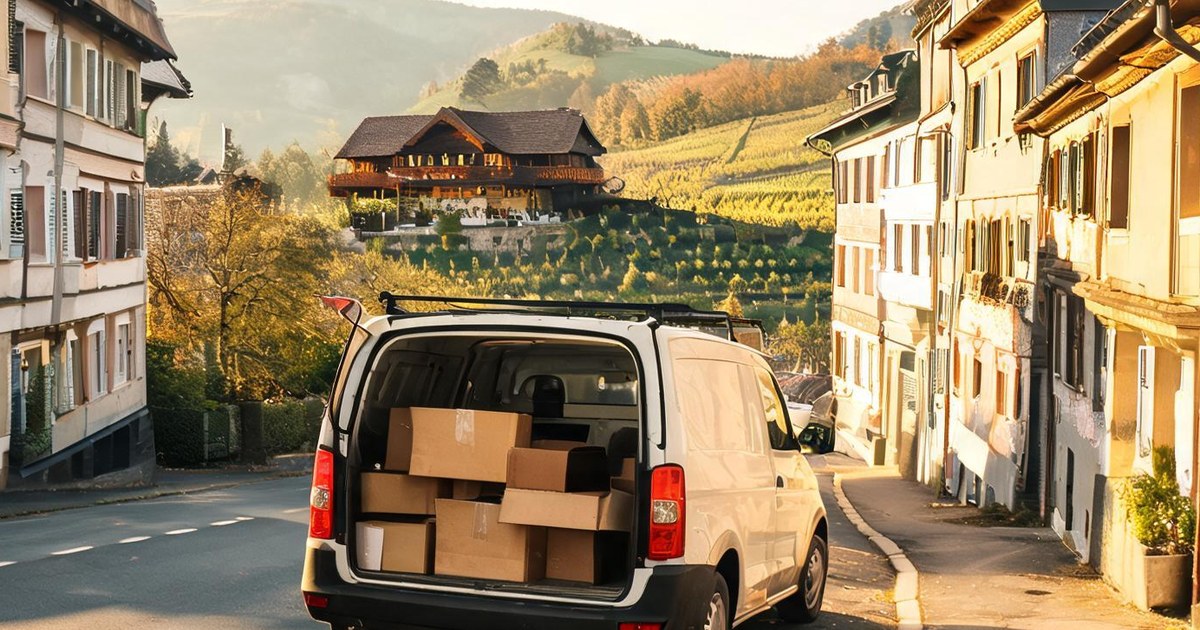
Moving from Germany to Austria: What It Really Costs
Moving from Germany to Austria: What It Really Costs The real cost of moving from Germany to Austria: removal firm vs van rental, fuel and vignette, Kaution and first rent, insurance, taxes, weekly checklist. Topics: Migration, Economy.
There is no border control between Germany and Austria, but the price tag for crossing it is very concrete. Moving from Germany to Austria costs a single person with a rented van €1,300–1,900 for belongings and the drive, while a family using a full removal firm (Spedition) pays €2,800–5,200. The heaviest item on the bill is not the boxes but the Kaution (rental deposit): up to three monthly rents. This guide collects the real numbers from practice: removal firm versus DIY, fuel and the ASFINAG vignette, residence registration, insurance, the tax return and the switch of child benefits. Everything is packed into a budget and a week-by-week checklist so you know the total before you book the van. Knowing the order of steps saves you double rent and penalty fees. All figures are market estimates for autumn 2026.
What moving from Germany to Austria costs in total
The short answer: you need between €1,700 and €16,000 at the start, depending on the scenario. A room in a shared flat (WG) works with €1,700–3,000, your own one-bedroom apartment needs €5,700–7,600, and a family moving into a three-bedroom flat should budget €10,300–16,200. In almost every case, entering the rental market eats half the budget — not the transport itself.
| Scenario | Belongings and drive | Entry into the apartment | Total at start |
|---|---|---|---|
| Single person, WG room | €400–800 | €1,300–2,200 | €1,700–3,000 |
| Single person, 1–2-bedroom flat, van | €1,300–1,900 | €4,400–5,700 | €5,700–7,600 |
| Family, removal firm, 3–4-bedroom flat | €2,800–5,200 | €7,500–11,000 | €10,300–16,200 |
Understand the structure behind the numbers: the Kaution is formally refunded when you move out, but you cannot live on it for three years. Plan for the cash-flow gap, not the “average moving cost”. A buffer of one monthly salary on top of the budget has, in our experience, rescued every second newcomer.
If you are still choosing a city and an apartment, start with our guide to renting in Austria — it breaks down the market, districts and contract types in detail.
Removal firm or rented van — which is cheaper
DIY is almost always cheaper: a van up to 3.5 tonnes costs €99–180 per day, keeping total logistics at €300–700. A full removal firm with packing service charges €1,800–3,200 for a two-bedroom apartment on the Munich—Vienna route — four to five times more, but without your own labour and with cargo insurance.
| Option | Munich → Vienna, 2-bedroom flat | Best for |
|---|---|---|
| Full removal firm | €1,800–3,200 | Families, lots of furniture, no time |
| Rented van (DIY) | €300–700 | Singles, students, minimal furniture |
| Hybrid: goods by firm, you by car | €1,000–1,700 | Those wary of driving a big van |
Both options hide extra costs. For the removal firm: surcharges for upper floors without a lift, long carries from truck to door, and short-notice bookings — reserve 4–6 weeks ahead. Boxes are usually included, but check the liability for mirrors and glassware in the contract: the standard covers only about €620 per cubic metre. For the van, plan half a day more than expected, because unloading always takes longer than loading. Fuel and the vignette are on you either way.
Two ways to cut the price without risk. First, the moving auction: describe your volume, firms bid against each other, and savings reach 30%. Second, split the transport: only the heavy pieces ride with the firm, the rest goes as parcel post for €150–300. And budget for the van’s return leg to Germany from the start — “forgetting” it is the most common budget mistake.

The drive: fuel, vignette and tolls
Munich to Vienna measures 450 km, Berlin to Vienna 680 km, Cologne to Vienna roughly 1,000 km. A loaded 3.5-tonne van burns 11–13 litres of diesel per 100 km — about €80–95 one way at the current diesel price of around €1.60. The empty return trip costs roughly the same again.
Austrian motorways require a vignette — the digital toll sticker for cars up to 3.5 tonnes. According to ASFINAG, the state road operator, the 10-day vignette costs €12.80 and the two-month vignette €32.00. The digital vignette is tied to your number plate and bought online. Trucks above 3.5 tonnes pay the kilometre-based Go-Maut instead — irrelevant for a rented moving van.
Plan the driving time too: Munich—Vienna takes 5–6 hours in a loaded van instead of four in a car. Sunday driving bans for heavy lorries in Austria make Saturday evening or Monday morning the best windows. Three side costs complete the picture: a trailer above 750 kg needs its own vignette, an electric van pays €0.45–0.69 per kWh at Austrian fast chargers, and a temporary no-parking zone in front of your Viennese building must be arranged with the city in advance — otherwise the first inspector writes the ticket.
Kaution, Provision and the first rent — the biggest cost item
Entering the Austrian rental market is the heaviest part of the budget. The Kaution (deposit) is capped by law at three monthly rents — that is §16b of the Austrian Tenancy Act (Mietrechtsgesetz). The Provision (broker’s fee) has been limited to two monthly rents since November 2023. Add the first rent, due immediately at signing.
A Vienna example: a 60 m² flat at €880 per month. Kaution €2,640, Provision €1,760, first rent €880. That is €5,280 before you open your own door for the first time. This block is exactly what most “moving cost” calculators forget.
You can soften the cash gap with a Mietkaution-Konto — a bank deposit account instead of handing over cash. You lock the same sum in a blocked account or pay the bank an annual fee of €30–60, and the landlord receives a bank guarantee. Insurance-based guarantees work as an alternative; Austrian landlords usually accept both models willingly. Three market nuances locals know: furnished flats outside the Tenancy Act can demand up to six monthly rents, cooperative housing (Genossenschaftswohnung) runs a quarter below market but charges membership fees of €1,500–4,000, and the deposit is refunded with interest — clarify whether service charges (Betriebskosten) are flat or billed, a difference worth €150 a month.
Bureaucracy: what is free and what costs money
The good news: the basic paperwork after moving from Germany to Austria is nearly free. The Meldezettel (residence registration) is done at the local municipal office within three working days of moving in and costs €0 — the process is described on oesterreich.gv.at, the official government portal. Without it: no bank account, no insurance, no regular mobile contract.
The registration of residence must take place within three working days of moving into the accommodation; it is free of charge for those affected.
— oesterreich.gv.at, Meldezettel section
Money starts where machinery and vehicles are involved. A full car re-registration costs about €270 plus insurance and, above certain CO₂ values, the NoVA tax — we break down every fee and step in our car re-registration guide. As an EU citizen, apply for the Anmeldebescheinigung (registration certificate) within the first four months; the small fee depends on the authority. German documents need no translation: same language, and inside the EU no apostille is required.

Small mandatory expenses belong in the budget too. The dog tax in Vienna is €72 per year for the first dog. Mobile contracts require an Austrian address, so a prepaid SIM for €10 covers the transition. A separate broadcasting fee no longer exists since 2024 — funding runs through income tax. Most Austrian banks charge €0 for a basic account with salary deposits.
Insurance: health cover without a gap
Health insurance when moving from Germany to Austria needs only two steps if you arrive with an employer. Step one: deregister (Abmeldung) from your German health fund with your move-out date. Step two: from your first working day, the Austrian employer automatically registers you with the ÖGK (Austrian Health Insurance Fund); contributions are split equally between employer and employee.
The gap before your first working day is covered by a private policy or voluntary continuation — €60–200 per month depending on age. The e-card arrives by post after two to four weeks, but you are treated from day one under your insurance number. German prescriptions only work through a new Austrian doctor, so bring a month of medication plus your medical records. Pensions are their own chapter: contributions paid in Germany are not lost — they wait in the German pension fund. We explain how they are later combined with Austrian contributions in our German pension in Austria article.
The other policies travel by choice: household and liability insurance are cheaper in Austria than in Germany — €10–25 per month each. Re-register them under the new address right after the Meldezettel, otherwise claims disputes are almost unwinnable. Car insurance switches to the Austrian scale after re-registration, and your German no-claims years (SF class) usually transfer — request the confirmation letter from your German insurer before leaving. Our health insurance guide maps the whole Austrian system.
Taxes and the tax return in the year of the move
The year of the move is the most rewarding moment for a tax return. In Germany, unlimited tax liability ends with relocating your main residence (Wohnsitzverlagerung) to Austria; income before the move stays taxable in Germany, income after it in Austria. The German return for the year of exit includes the Austrian income under the progression rule (Progressionsvorbehalt).
In Austria, the employer first files the Arbeitnehmerverrechnung (employee tax assessment) automatically. If you worked fewer than twelve months in Austria, filing your own return pays: the Austrian tariff applies only to Austrian months, and the year of the move often refunds €300–800 through standard credits — the transport credit (Verkehrsabsetzbetrag) and the employee credit (Arbeitnehmerabsetzbetrag). The automatic assessment arrives in autumn; you request the recalculation yourself via FinanzOnline.
The double taxation treaty between Germany and Austria rules out double taxation within the year of the move. Practical tip: keep your German wage tax statement (Lohnsteuerbescheinigung) — both countries need it. Keep moving invoices too: in Germany, a move closer to your workplace is deductible as Umzugskosten (moving expenses).
Child benefits: Kindergeld and Familienbeihilfe
Family benefits from Germany and Austria are not added together: one country pays. In Germany, Kindergeld (child benefit) stands at €259 per child per month in 2026 — figures per Kindergeld.org, the German specialist portal. After you deregister, the German family fund stops the payments.
The Austrian model pays more for larger families. According to oesterreich.gv.at, Familienbeihilfe (family allowance) in 2026 is €138.40 per month per child from birth, €171.80 from age ten and €200.40 from age nineteen, plus a €8.60 sibling supplement from the second child. The entitlement starts on the first day of residence, the application goes to the Finanzamt Österreich, and it applies retroactively to the month of the move.
In August, an extra school start payment (Schulstartgeld) of €121.40 per child aged six to fifteen arrives. Apply within the first weeks: payments run from the application date, not the move date. We compare both systems and the application path in our Familienbeihilfe overview. EU coordination rules exclude double payments: the family’s habitual residence decides.

A real example: moving costs from Munich to Vienna
A case from practice: a single person, two-bedroom flat, furniture travelling in a rented van. Van rental over the weekend (Friday to Monday) €420. Diesel for about 900 km €165. Ten-day vignette €12.80. Boxes, stretch film and straps €65 — that is all the transport side needs.
The housing block: rent €880, Kaution three monthly rents €2,640, Provision two rents €1,760, bridging insurance until the first working day €120, initial setup and small deposits €300. In total, a €6,363 cash-flow gap. But €2,640 of that is a refundable deposit — the truly spent money comes to €3,723. If the landlord has no broker, the Provision disappears and you save another €1,760 in one stroke.
For comparison: the same move with a full removal firm adds €1,800–2,400, while a single person taking a WG room gets by on €1,900 with no Provision at all. The rule is simple: every extra cubic metre of furniture and every step up the housing ladder costs money. Budget the apartment, not the van.
And the view back shows that moving from Germany to Austria is cheaper than the reverse direction. Average rent in Vienna sits below Munich or Hamburg, and the cost of living runs 15–20% below Germany’s major cities. If your employer is location-independent, the rent difference covers the whole moving budget twice within a year. That is why budget-conscious households more often move east than west. Germany remains the work partner; Austria wins on everyday costs.
Week-by-week checklist: from decision to Meldezettel
This timeline saves the most money. Twelve weeks out: pick the city, sign the job contract, collect quotes from removal firms. Eight weeks out: organise the German flat — notice periods run three months — and start viewings. Four weeks out: deregister from doctors and insurers, organise the children’s school switch, book the van or the firm.
Two weeks out: open an Austrian account online and assemble the document folder — passport, rental contract, income statements, children’s birth certificates. One week out: cancel subscriptions, close pet and vehicle registrations where needed, say goodbye to the neighbours. Label the boxes by room and keep a bag with essentials: documents, chargers, medication, bedding — it saves the first night while the furniture is still on the road. Defrost the fridge two days before loading, or you ship water into the new flat.
The first week after arrival is the densest: Meldezettel within three working days, insurance before the first working day, electricity and gas meters into your name, internet ordered. Three things newcomers forget: cancelling the old parking-space fee, switching the Viennese short-term parking permit, and notifying their bank. The complete first-steps list lives in our guide to moving to Austria.
Frequently Asked Questions
Are there customs duties when moving from Germany to Austria?
No. Both countries are in the EU and the customs union, so household goods travel freely without declarations. Cars are their own chapter: at registration, the Austrian NoVA tax is calculated by the CO₂ formula — run that calculation before deciding whether to take the car at all.
How much money should you bring for the first month?
A single person needs at least €4,000–5,000 beyond the transport: deposit, first rent, insurance, initial setup. A family from €8,000. A buffer of one monthly salary on top turns the move from stress into routine.
What is cheaper — taking furniture or buying new in Austria?
Think in cubic metres: furniture from German budget chains costs the same in their Austrian branches. Taking things makes sense for expensive electronics, family heirlooms and bicycles. Everything flat-pack is cheaper to buy locally — Viennese delivery is free from €50.
Is the German driving licence valid in Austria?
Yes, indefinitely for category B. Exchanging it is optional but simplifies everyday life and costs only a small fee. Details are in our driving licence guide.
Can you receive Kindergeld from Germany and Familienbeihilfe from Austria at the same time?
No, double payments are excluded. The country of the family’s habitual residence pays, usually from the month of the move. Apply for Familienbeihilfe in the first days at the Finanzamt Österreich — payments run from the application date, never retroactively before that. If the German family fund keeps paying by mistake, pay it back voluntarily: at audit time the overpayment becomes a debt.
What comes next: keeping control of your moving budget
Moving from Germany to Austria costs what entering the Austrian housing market costs; everything else is small change. Do not budget the “average move” — build your own estimate in three blocks: belongings and drive (€300–5,200), bureaucracy and insurance (€100–400), the apartment (€1,300–11,000 with a refundable deposit). The short checklist: price the flat and Kaution → choose a removal firm or a van → plan the route and vignette → Meldezettel within three days → file the tax return in the year of the move → apply for Familienbeihilfe. If the budget is honest, the border between Munich and Vienna is the cheapest part of the journey. Re-check the estimate a week before the drive: van and fuel prices move with the seasons. Subscribe to our newsletter to stay on top of price and rule changes.
Stay Up to Date with the Latest Austrian News
The week's top stories — news, guides, and insights about life in Austria. Every Sunday in your inbox.