Heating Season in Austria: When Can You Turn On the Heating and Is There a Limit?
Heating Season in Austria: When Can You Turn On the Heating and Is There a Limit? Heating season in Austria is not fixed by law. When to start heating, which room temperatures are recommended and who pays for boiler repairs and servicing? Topics: Daily Life, Housing, Economy.
Every autumn, the same heating questions appear in expat chats across Austria. Is there an official date when you are finally “allowed” to switch on the radiators? Can your landlord stop you from heating in September? And does a Heizlimit really exist, some kind of legal maximum temperature for your flat? The short answer: heating season in Austria is not defined by law, and nobody caps the temperature inside your home. Still, there are clear rules about landlord duties, boiler servicing and ventilation that every tenant should know. This guide covers the dates, the recommended temperatures, your rights and the classic mistakes that end with mould on the walls and a bill for someone else’s repair.
Is there an official heating season in Austria
Austria has no legally defined heating season. No federal law names a date on which heating becomes “permitted”. As The Local Austria reports, there is no statutory heating period, but there is a well-established convention: heating is typically needed between 1 October and 30 April.
Treat these dates as a rule of thumb, not as a rule. The City of Graz housing guide states plainly that no legally fixed Heizperiode (heating period) exists, and that climate change keeps shifting the window. October is often warm and the radiators can stay low, while May is sometimes unusually cold, and then heating must be available even though the calendar “season” is over.
The underlying legal principle is different from a fixed start date. A landlord owes the tenant the durchschnittliche Brauchbarkeit (average usability) of the flat. In practice this means the home must allow you to reach an angemessene Raumtemperatur (appropriate room temperature) whenever it is genuinely cold outside, not only between official dates.
When you can turn on the heating in your flat
You can switch on the heating on any day of the year. Austrian law contains no ban on heating “out of season”, so if your flat is cold at the end of September, you are not required to wait until 1 October. Deciding when and how much to heat is up to the tenant and their own sense of cold.
One caveat applies to buildings with central heating (Zentralheizung). In apartment blocks, the system is switched on and off centrally, and individual tenants often have no direct control over it. If temperatures drop before the heating is running, ask the landlord or the property management company (Hausverwaltung) to start the system earlier. They cannot refuse to provide heat during a real cold snap: the duty to ensure an adequate temperature does not expire with the “season”.
A related myth is the so-called Heizstopp, a ban on heating. House rules (Hausordnung) or the rental contract may regulate when the central boiler runs, for example night breaks. But a landlord cannot forbid you from using the heating in your own flat during cold weather. Such a clause would contradict the core obligation to hand over and maintain a usable home.
Is there a Heizlimit on how high you can heat
There is no legal maximum temperature for flats in Austria. Neither the MRG tenancy law nor the housing regulations of the federal states set a ceiling to which you may heat a room. The recommended values discussed below are health and mould-prevention guidelines, not a legal maximum.
The only real “limit” is your energy bill. According to the City of Graz guide, every additional degree raises annual heating costs by roughly 6%. So “you may heat to 30°C” and “you should” are different questions: restraint here is purely financial, never legal.
Expats from Germany often ask how the rules compare. The German Heizperiode of 1 October to 30 April is not a law either: it is a guideline derived from court practice in landlord-tenant disputes. The Austrian approach phrases the duty differently: the law demands usability of the flat and the ability to reach an adequate temperature, with no calendar attachment. The tenant’s conclusion is identical in both countries: when it is cold, you may and should heat.
| Criterion | Austria | Germany |
|---|---|---|
| Official season start date | None | None, guideline 1 October |
| Guideline end date | 30 April | 30 April |
| Criterion for heating | Adequate temperature in the flat | Court practice, heating by weather |
| Maximum temperature | None | None |
The reverse situation is regulated much more strictly: heating too little is the tenant’s problem. If a flat stays cold, the walls cool down, condensation forms, and mould follows. We cover the risks in detail below, because damage caused by wrong heating and ventilation habits is something the tenant pays for.
The recommended temperature values are guidance, not instructions. The landlord’s duty is to enable an appropriate room temperature, while the decision on how warm to keep the flat stays with the tenant.
- Wohnungsinformationsstelle (WOIST), City of Graz guide on the start of the heating season
Recommended room temperatures during the cold months
Although the law sets neither a minimum nor a maximum, housing advice bodies in Austria converge on the same standard values. They keep you healthy and protect the walls from moisture. According to Stadt Graz and The Local, the recommended winter temperatures are:
| Room | Recommended temperature |
|---|---|
| Living room (Wohnraum) | 20-22°C |
| Kitchen | 20-22°C |
| Bedroom | 18-20°C |
| Bathroom (Bad) | 24°C |
| Toilet (WC) | 16-18°C |
| Heated hallways and utility rooms | 16-18°C |
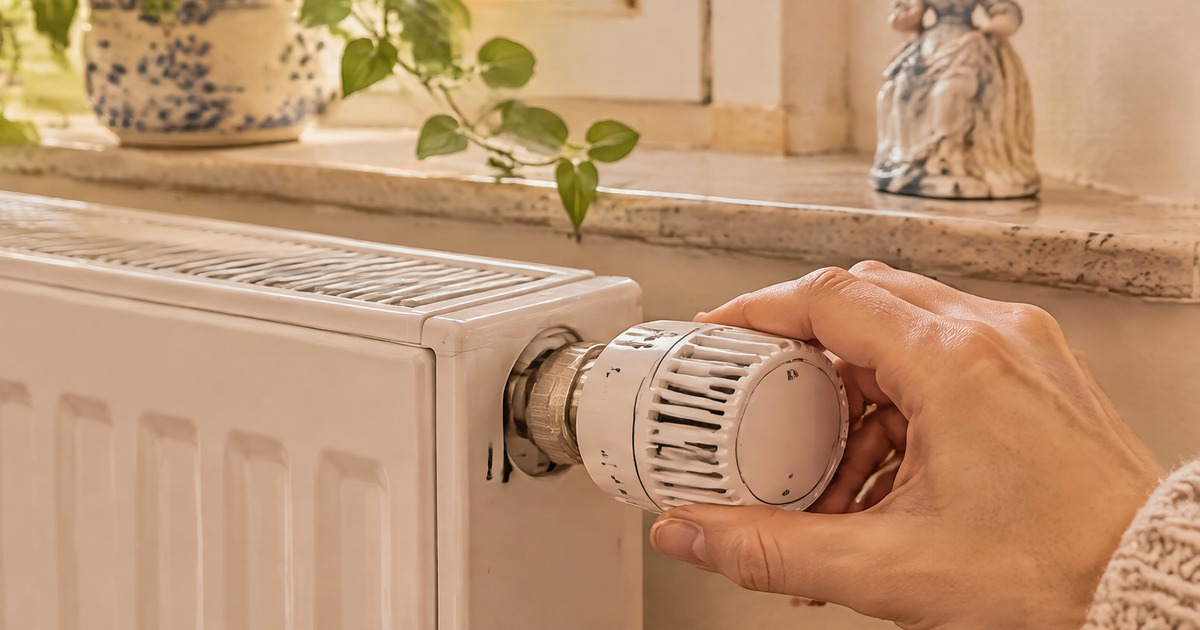
The dial on each radiator (Heizkörper) makes these values easy to hit: settings 1 to 5 roughly correspond to them. Level 3 usually produces around 20°C in a room, which is enough for the living room during the day. At night a lower setting is more comfortable for sleeping, so turn the bedroom radiator down to level 2.
Aim for stable temperatures rather than blasting the flat in the evening and letting it cool during the day. Rapid swings cool down the walls and create condensation exactly where warm air meets cold surfaces: in corners, behind wardrobes and on external walls.
Landlord duties for heating systems
Responsibility for the heating equipment itself lies with the landlord. The legal basis is the Mietrechtsgesetz (MRG, the Austrian tenancy law). Under § 3 MRG, maintenance obligations cover mitvermietete Heizthermen (boilers and heating appliances let together with the flat), hot water tanks and other heat supply devices, as well as shared systems, including zentrale Wärmeversorgungsanlagen (central heat supply systems).
Since the Wohnrechtsnovelle 2015 (the 2015 housing law amendment) these rules apply to all rented flats except single and two-family houses. If the gas boiler or radiators were part of the flat when you moved in, their upkeep and repair are the landlord’s duty and cost. Arbeiterkammer (the Austrian Chamber of Labour, the main consumer advice body) confirms that replacing a broken Heiztherme (gas boiler) in a rented flat is the owner’s job, not the tenant’s.
This has a practical consequence for anyone still looking for a home. At a flat viewing in Vienna, always ask about the age and type of heating, and check the contract for the list of equipment included in the rental. It determines who pays for the next repair.
Tenant duties: servicing your Heiztherme
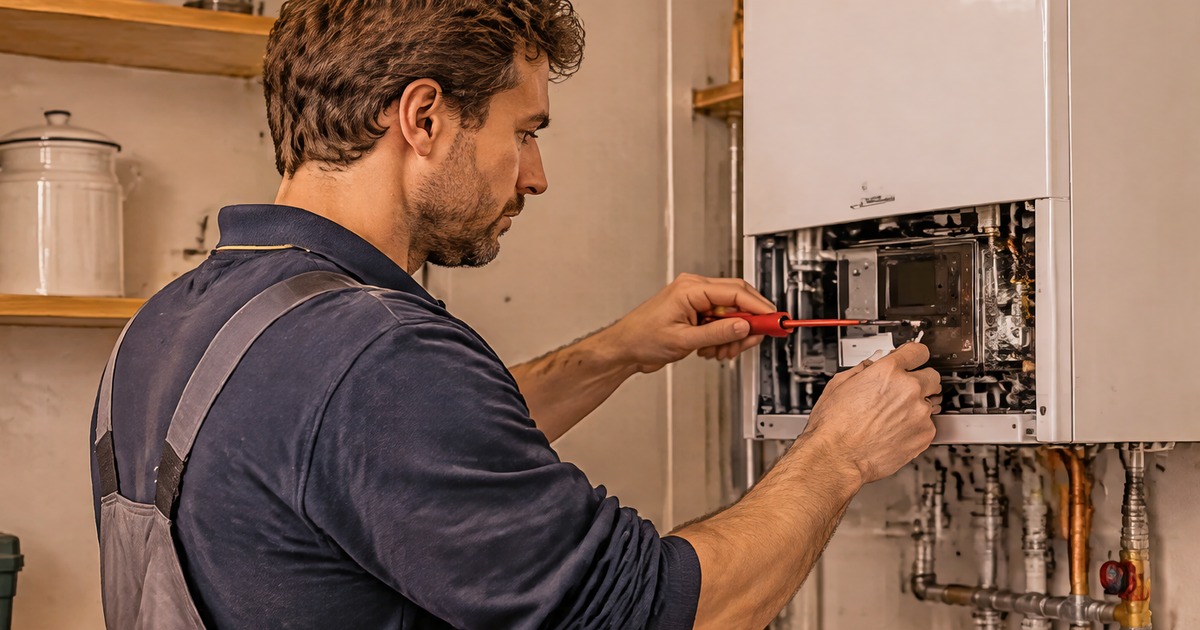
Tenants have their own area of responsibility: the Wartung (servicing) of appliances let together with the flat. Under the same 2015 amendment, the tenant must service the boiler, water heater or other heat source at their own cost. That means cleaning, checking and keeping the device in working order, not repairing or replacing it.
The standard servicing interval is 1 to 2 years; the exact figure depends on the type, age and condition of the appliance. The manufacturer states the recommended interval in the manual, and if the manual is missing, ask the landlord. The City of Graz recommends a seasonal ritual: switch on every radiator, check that it heats evenly and bleed it (entlüften) if part of the surface stays cold.
The most expensive mistake is not keeping documents. Store every servicing record (Wartungsprotokoll) for the whole tenancy. If the boiler breaks and the landlord proves the failure was caused by missed servicing, the tenant carries the cost of the damage. With complete records, you can prove the opposite.
What to do when the heating breaks
If the radiators or boiler fail, act in writing. The tenant must inform the landlord immediately and in written form about the defect and demand the repair. An email describing the problem with a date is the minimum evidence; a photo of the cold radiator and the thermostat makes the case stronger.
While the defect remains unfixed and the flat cannot be heated properly, the tenant gains the right to Mietzinsminderung (rent reduction). The conditions are simple: the fault is not yours and it really prevents an adequate temperature. Important: the right to a rent reduction is lost if you attempt the repair yourself. Skip the handyman advert and write to the landlord instead, because repairs to the Heiztherme in a rented flat are his responsibility anyway.
If the landlord ignores you, bring in the advisers: Arbeiterkammer offers free advice, and cities such as Vienna and Graz run tenant counselling services (Mieterberatung, WOIST). For context on keeping documentation tight from day one, our guide on rental scams in Austria shows how to record agreements so you are not left without proof later.
Still looking for a rental? Keep our guide to renting a flat in Austria bookmarked: it covers contract types, tenant rights and the questions worth asking before signing. A solid contract is the best protection against winter disputes over cold radiators.
Why heating too little is expensive
The paradox of saving: trying to cut the heating bill often creates the biggest costs. Under-heated walls cool below the dew point, condensation forms, and within weeks Schimmel (mould) appears. Old buildings (Altbau) and poorly insulated flats are especially vulnerable, and Austria’s housing stock includes plenty of them.
Mould is more than a renovation problem. Mould spores trigger allergies and respiratory problems, and living in a cold, damp flat weakens the immune system. In Austrian contracts and case law, damage from falsches Heiz- und Lüftungsverhalten (wrong heating and ventilation behaviour) is a classic ground for landlord claims against tenants. In plain terms: heat too little and you pay for drying out the walls and the repairs.
Winter physics adds another risk. Water pipes in an unheated flat can freeze, and ice bursts the pipes, causing a Rohrbruch (burst pipe). The damage from flooding an apartment building runs into thousands of euros and affects your neighbours too. Saving a few dozen euros on heating against that risk is not a difficult choice.
Electric heaters: a temporary fix with a long bill
When the central heating has not started yet and the flat is already cold, many people unpack an electric heater. There is no ban on it: using a portable device in a rented flat is your everyday decision. What you cannot do is install anything permanently without the landlord’s written consent, since fixed changes to the flat always require an agreement.
Do the maths first. A 2000 W heater running 3 hours a day consumes 6 kWh. At a typical tariff of around 25 cents per kWh, that is roughly €1.5 per day, or €45 per month for a single room. Electricity is almost always more expensive than gas or district heat per unit of warmth, so an electric heater is a tool for a cold bedroom for a couple of weeks, not a full-season replacement for central heating.
Mind the safety rules as well. Do not dry laundry on the heater, do not leave it running overnight, and keep half a metre of clear space around the device. If it plugs into old wiring through an extension cord, check whether the socket gets warm: overloaded extension leads are a common cause of winter fires.
How to save on heating without getting mould
The good news: you can stay warm in Austria without overspending. Start with the thermostat settings: levels 1-5 deliver the predictable temperatures from the table above instead of a binary “too hot or too cold”. Use level 3 in living rooms and turn the bedroom radiators down at night.
The second tool is Stoßlüften (short, intense cross-ventilation): open the windows wide for a few minutes, three to five times a day, with the radiators turned off during that time. Keeping windows permanently tilted is a poor strategy: the walls near the window cool down while the gas bill climbs. The third is simple: never block radiators with furniture or heavy curtains, because a covered heater warms the wall and the wardrobe, not the room.
Combine this with closed shutters or thick curtains at night, draught-proof the front door, and check whether you are heating the street through old windows. More ways to trim your utility costs are collected in our guide to energy prices in winter, and if you are thinking about long-term energy independence, see our overview of solar panel subsidies.

No guide to the heating season in Austria is complete without the question of how these costs are actually calculated. In buildings with central heating, the cost of warmth does not arrive in the gas bill but in the annual statement of operating costs (Betriebskostenabrechnung). Heating is the largest and most disputed line in it, so review it instead of paying silently.
Checking starts with simple numbers. Compare your consumption with last year and with a benchmark: for an average Austrian flat, dozens of kWh of heat per square metre per year is a reasonable range, and a sharp jump from one year to the next demands an explanation. If the building has consumption meters (Verbrauchsermittlung), your statement must reflect your actual usage, not an average for the whole house. Installing such devices is provided for by § 3 MRG and § 17 MRG, so “we do not meter consumption” has a legal answer.
Contested lines are handled by the advisers: Arbeiterkammer publishes step-by-step instructions for checking a heating bill, and housing advice centres such as WOIST in Graz review statements free of charge. Bring two years of statements: the year-over-year trend speaks louder than a single figure.
Frequently Asked Questions
Can I turn on the heating before 1 October?
Yes. There is no official heating season in Austria; the 1 October to 30 April window is only a convention. In a cold September you may heat, and the landlord must enable an adequate room temperature. In buildings with Zentralheizung, ask the Hausverwaltung to start the system earlier; during real cold weather they cannot refuse.
Is there a Heizlimit or a fine for heating too much?
No. No law sets a temperature ceiling for your own flat. The recommended values of 20-22°C for the living room and 24°C for the bathroom are health and mould-prevention advice. The only constraint is your bill: every extra degree adds roughly 6% to annual heating costs.
Who pays for a broken gas boiler?
Repair and replacement of boilers or radiators included in the rental are the landlord’s cost, based on § 3 MRG and the Wohnrechtsnovelle 2015. The tenant only covers regular servicing (Wartung) at their own expense and keeps the servicing records. If the failure resulted from missed servicing, the tenant may carry the cost of the damage.
Can the Hausordnung forbid heating?
A complete ban on heating is not possible, neither through the Hausordnung nor the contract. House rules may regulate the operation of the central boiler, for example night breaks of the central heating. But keeping the flat in a condition where an adequate temperature is reachable is the landlord’s duty, valid all year round, not only “in season”.
What to do today: a short checklist
Here is the summary. Heating season in Austria is a convention, not a paragraph of law: a rule of thumb from 1 October to 30 April, with no ban dates and no temperature limit. Getting ready for the cold takes an afternoon.
- Check every radiator: does it heat evenly, are there cold zones; bleed it if needed.
- Schedule the boiler Wartung if the 1-2 year interval is due, and keep the record.
- Set the thermostats: level 3 for living rooms, lower for the bedroom at night.
- Practise Stoßlüften three to five times a day with the radiators off.
- Save the landlord or Hausverwaltung contacts for emergencies, and always write to them.
If the heating breaks, demand the repair in writing and never fix it yourself: appliances included in the rental are the landlord’s responsibility, and you are entitled to a rent reduction meanwhile. And to keep up with new housing rules and payouts, subscribe to our newsletter - we explain everyday life in Austria without the legal jargon.
Stay Up to Date with the Latest Austrian News
The week's top stories - news, guides, and insights about life in Austria. Every Sunday in your inbox.